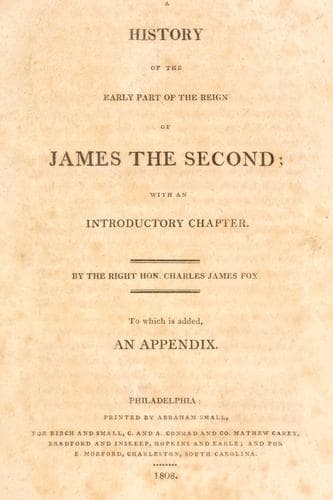
A History of the Early Part of the Reign of James the SecondFox, Charles James
History
A History of the Early Part of the Reign of James the Second
Fox, Charles James
Great Britain -- History -- James II, 1685-1688
Many circumstances contributed to outweigh the scruples which must have
harassed a man of his excellent nature, when he considered the
obligations of filial duty and gratitude, and when he reflected that the
particular relation in which he stood to the king rendered a conduct,
which in any other subject would have been meritorious, doubtful, if not
extremely culpable in him. Among these, not the least was the declared
enmity which subsisted between him and his uncle, the Duke of York. The
Earl of Mulgrave, afterwards Duke of Buckinghamshire, boasted in his
"Memoirs," that this enmity was originally owing to his contrivances; and
while he is relating a conduct, upon which the only doubt can be, whether
the object or the means were the most infamous, seems to applaud himself
as if he had achieved some notable exploit. While, on the one hand, a
prospect of his uncle's succession to the crown was intolerable to him,
as involving in it a certain destruction of even the most reasonable and
limited views of ambition which he might entertain, he was easily led to
believe, on the other hand, that no harm, but the reverse, was intended
towards his royal father, whose reign and life might become precarious if
he obstinately persevered in supporting his brother; whereas, on the
contrary, if he could be persuaded, or even forced, to yield to the
wishes of his subjects, he might long reign a powerful, happy, and
popular prince.
It is also reasonable to believe, that with those personal and private
motives others might co-operate of a public nature and of a more noble
character. The Protestant religion, to which he seems to have been
sincerely attached, would be persecuted, or perhaps exterminated, if the
king should be successful in his support of the Duke of York and his
faction. At least, such was the opinion generally prevalent, while, with
respect to the civil liberties of the country, no doubt could be
entertained, that if the court party prevailed in the struggle then
depending they would be completely extinguished. Something may be
attributed to his admiration of the talents of some, to his personal
friendship for others among the leaders of the Whigs, more to the
aptitude of a generous nature to adopt, and, if I may so say, to become
enamoured of those principles of justice, benevolence, and equality,
which form the true creed of the party which he espoused. I am not
inclined to believe that it was his connection with Shaftesbury that
inspired him with ambitious views, but rather to reverse cause and
effect, and to suppose that his ambitious views produced his connection
with that nobleman; and whoever reads with attention Lord Grey's account
of one of the party meetings at which he was present, will perceive that
there was not between them that perfect cordiality which has been
generally supposed; but that Russell, Grey, and Hampden, were upon a far
more confidential footing with him. It is far easier to determine
Public-domain text, read in full here on John Shaqi.
Reviews
Reviews
No reviews yet
Be the first to share your thoughts on this work.
Elsewhere in the archive
Join the Discussion
Join the discussion
Sign in to leave a comment or review.
Sign InorCreate an account