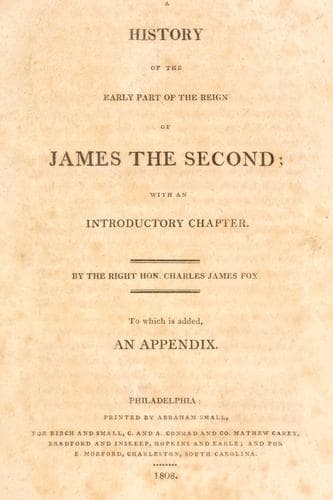
A History of the Early Part of the Reign of James the SecondFox, Charles James
History
A History of the Early Part of the Reign of James the Second
Fox, Charles James
Great Britain -- History -- James II, 1685-1688
generally, that he had high schemes of ambition, than to discover what
was his precise object; and those who boldly impute to him the intention
of succeeding to the crown, seem to pass by several weighty arguments,
which make strongly against their hypothesis; such as his connection with
the Duchess of Portsmouth, who, if the succession were to go to the
king's illegitimate children, must naturally have been for her own son;
his unqualified support of the Exclusion Bill, which, without indeed
mentioning her, most unequivocally settled the crown, in case of a
demise, upon the Princess of Orange; and, above all, the circumstance of
his having, when driven from England, twice chosen Holland for his
asylum. By his cousins he was received, not so much with the civility
and decorum of princes, as with the kind familiarity of near relations, a
reception to which he seemed to make every return of reciprocal
cordiality. It is not rashly to be believed, that he, who has never been
accused of hardened wickedness, could have been upon such terms with, and
so have behaved to, persons whom he purposed to disappoint in their
dearest and best grounded hopes, and to defraud of their inheritance.
Whatever his views might be, it is evident that they were of a nature
wholly adverse, not only to those of the Duke of York, but to the schemes
of power entertained by the king, with which the support of his brother
was intimately connected. Monmouth was therefore, at the suggestion of
James, ordered by his father to leave the country, and deprived of all
his offices, civil and military. The pretence for this exile was a sort
of principle of impartiality, which obliged the king, at the same time
that he ordered his brother to retire to Flanders, to deal equal measure
to his son. Upon the Duke of York's return (which was soon after),
Monmouth thought he might without blame return also; and persevering in
his former measures and old connections, became deeply involved in the
cabals to which Essex, Russell, and Sidney fell martyrs. After the death
of his friends, he surrendered himself; and upon a promise that nothing
said by him should be used to the prejudice of any of his surviving
friends, wrote a penitentiary letter to his father, consenting, at the
same time, to ask pardon of his uncle. A great parade was made of this
by the court, as if it was designed by all means to goad the feelings of
Monmouth: his majesty was declared to have pardoned him at the request of
the Duke of York, and his consent was required to the publication of what
was called his confession. This he resolutely refused at all hazards,
and was again obliged to seek refuge abroad, where he had remained to the
period of which we are now treating.
Public-domain text, read in full here on John Shaqi.
Reviews
Reviews
No reviews yet
Be the first to share your thoughts on this work.
Elsewhere in the archive
Join the Discussion
Join the discussion
Sign in to leave a comment or review.
Sign InorCreate an account