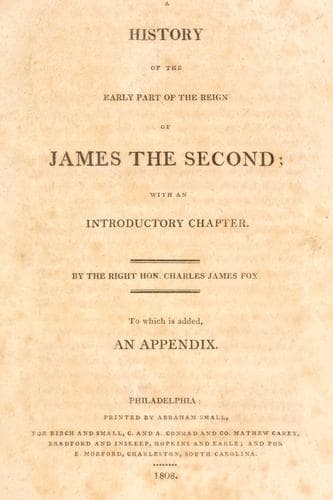
A History of the Early Part of the Reign of James the SecondFox, Charles James
History
A History of the Early Part of the Reign of James the Second
Fox, Charles James
Great Britain -- History -- James II, 1685-1688
A little time before Charles's death he had indulged hopes of being
recalled; and that his intelligence to that effect was not quite
unfounded, or if false, was at least mixed with truth, is clear from the
following circumstance:--From the notes found when he was taken, in his
memorandum book, it appears that part of the plan concerted between the
king and Monmouth's friend (probably Halifax), was that the Duke of York
should go to Scotland, between which, and his being sent abroad again,
Monmouth and his friends saw no material difference. Now in Barillon's
letters to his court, dated the 7th of December, 1684, it appears that
the Duke of York had told that ambassador of his intended voyage to
Scotland though he represented it in a very different point of view, and
said that it would not be attended with any diminution of his favour or
credit. This was the light in which Charles, to whom the expressions,
"to blind my brother, not to make the Duke of York fly out," and the
like, were familiar, would certainly have shown the affair to his
brother, and therefore of all the circumstances adduced, this appears to
me to be the strongest in favour of the supposition, that there was in
the king's mind a real intention of making an important, if not a
complete, change in his councils and measures.
Besides these two leaders, there were on the continent at that time
several other gentlemen of great consideration. Sir Patrick Hume, of
Polworth, had early distinguished himself in the cause of liberty. When
the privy council of Scotland passed an order, compelling the counties to
pay the expense of the garrisons arbitrarily placed in them, he refused
to pay his quota, and by a mode of appeal to the court of session, which
the Scotch lawyers call a bill of suspension, endeavoured to procure
redress. The council ordered him to be imprisoned, for no other crime,
as it should seem, than that of having thus attempted to procure, by a
legal process, a legal decision upon a point of law. After having
remained in close confinement in Stirling Castle for near four years, he
was set at liberty through the favour and interest of Monmouth. Having
afterwards engaged in schemes connected with those imputed to Sidney and
Russell, orders were issued for seizing him at his house in Berwickshire;
but having had timely notice of his danger from his relation, Hume of
Ninewells, a gentleman attached to the royal cause, but whom party spirit
had not rendered insensible to the ties of kindred and private
friendship, he found means to conceal himself for a time, and shortly
after to escape beyond sea. His concealment is said to have been in the
family burial-place, where the means of sustaining life were brought to
him by his daughter, a girl of fifteen years of age, whose duty and
affection furnished her with courage to brave the terrors, as well
superstitious as real, to which she was necessarily exposed in an
intercourse of this nature.
Public-domain text, read in full here on John Shaqi.
Reviews
Reviews
No reviews yet
Be the first to share your thoughts on this work.
Elsewhere in the archive
Join the Discussion
Join the discussion
Sign in to leave a comment or review.
Sign InorCreate an account