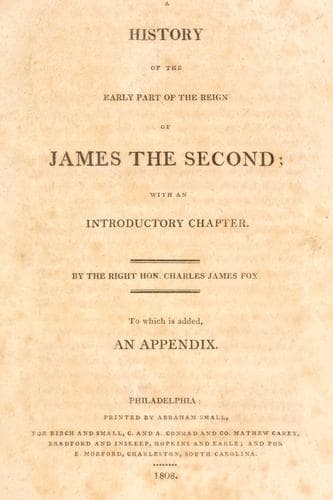
A History of the Early Part of the Reign of James the SecondFox, Charles James
History
A History of the Early Part of the Reign of James the Second
Fox, Charles James
Great Britain -- History -- James II, 1685-1688
Richard Rumbold, on every account, merits more particular notice. He had
formerly served in the republican armies; and adhering to the principles
of liberty which he had imbibed in his youth, though nowise bigoted to
the particular form of a commonwealth had been deeply engaged in the
politics of those who thought they saw an opportunity of rescuing their
country from the tyrannical government of the late king. He was one of
the persons denounced in Keeling's narrative, and was accused of having
conspired to assassinate the royal brothers in their road to Newmarket,
an accusation belied by the whole tenor of his life and conduct, and
which, if it had been true, would have proved him, who was never thought
a weak or foolish man, to be as destitute of common sense as of honour
and probity. It was pretended that the seizure of the princes was to
take place at a farm called Rye House, which he occupied in Essex, for
the purposes of his trade as maltster; and from this circumstance was
derived the name of the Rye House Plot. Conscious of having done some
acts which the law, if even fairly interpreted and equitably
administered, might deem criminal, and certain that many which he had not
done would be both sworn and believed against him, he made his escape,
and passed the remainder of Charles's reign in exile and obscurity; nor
is his name, as far as I can learn, ever mentioned from the time of the
Rye House Plot to that of which we are now treating.
It is not to be understood that there were no other names upon the list
of those who fled from the tyranny of the British government, or thought
themselves unsafe in their native country, on account of its violence,
besides those of the persons above mentioned, and of such as joined in
their bold and hazardous enterprise. Another class of emigrants, not
less sensible probably to the wrongs of their country, but less sanguine
in their hopes of immediate redress, is ennobled by the names of Burnet
the historian and Mr. Locke. It is difficult to accede to the opinion
which the first of these seems to entertain, that though particular
injustices had been committed, the misgovernment had not been of such a
nature as to justify resistance by arms. But the prudential reasons
against resistance at that time were exceedingly strong; and there is no
point in human concerns wherein the dictates of virtue and worldly
prudence are so identified as in this great question of resistance by
force to established government. Success, it has been invidiously
remarked, constitutes in most instances the sole difference between the
traitor and the deliverer of his country. A rational probability of
success, it may be truly said, distinguishes the well-considered
enterprise of the patriot, from the rash schemes of the disturber of the
public peace. To command success is not in the power of man; but to
deserve success, by choosing a proper time, as well as a proper object,
Public-domain text, read in full here on John Shaqi.
Reviews
Reviews
No reviews yet
Be the first to share your thoughts on this work.
Elsewhere in the archive
Join the Discussion
Join the discussion
Sign in to leave a comment or review.
Sign InorCreate an account