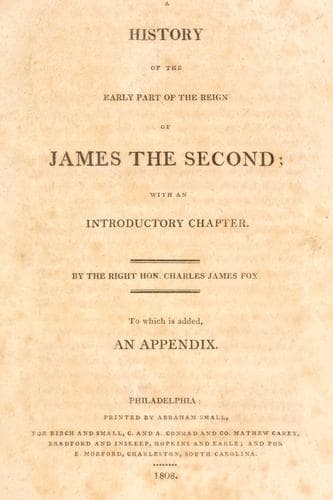
A History of the Early Part of the Reign of James the SecondFox, Charles James
History
A History of the Early Part of the Reign of James the Second
Fox, Charles James
Great Britain -- History -- James II, 1685-1688
by the prudence of his means, no less than by the purity of his views, by
a cause not only intrinsically just, but likely to insure general
support, is the indispensable duty of him who engages in an insurrection
against an existing government. Upon this subject the opinion of Ludlow,
who, though often misled, appears to have been an honest and enlightened
man, is striking and forcibly expressed. "We ought," says he, "to be
very careful and circumspect in that particular, and at least be assured
of very probable grounds to believe the power under which we engage to be
sufficiently able to protect us in our undertaking; otherwise I should
account myself not only guilty of my own blood, but also, in some
measure, of the ruin and destruction of all those that I should induce to
engage with me, though no cause were never so just." Reasons of this
nature, mixed more or less with considerations of personal caution, and
in some, perhaps, with dislike and distrust of the leaders, induced many,
who could not but abhor the British government, to wait for better
opportunities, and to prefer either submission at home, or exile, to an
undertaking which, if not hopeless, must have been deemed by all
hazardous in the extreme.
In the situation in which these two noblemen, Argyle and Monmouth, were
placed, it is not to be wondered at if they were naturally willing to
enter into any plan by which they might restore themselves to their
country; nor can it be doubted but they honestly conceived their success
to be intimately connected with the welfare, and especially with the
liberty of the several kingdoms to which they respectively belonged.
Monmouth, whether because he had begun at this time, as he himself said,
to wean his mind from ambition, or from the observations he had made upon
the apparently rapid turn which had taken place in the minds of the
English people, seems to have been very averse to rash counsels, and to
have thought that all attempts against James ought at least to be
deferred till some more favourable opportunity should present itself. So
far from esteeming his chance of success the better, on account of there
being in James's parliament many members who had voted for the Exclusion
Bill, he considered that circumstance as unfavourable. These men, of
whom, however, he seems to have over-rated the number, would, in his
opinion, be more eager than others to recover the ground they had lost,
by an extraordinary show of zeal and attachment to the crown. But if
Monmouth was inclined to dilatory counsels, far different were the views
and designs of other exiles, who had been obliged to leave their country
on account of their having engaged, if not with him personally, at least
in the same cause with him, and who were naturally enough his advisers.
Among these were Lord Grey of Wark, and Ferguson; though the latter
afterwards denied his having had much intercourse with the duke, and the
Public-domain text, read in full here on John Shaqi.
Reviews
Reviews
No reviews yet
Be the first to share your thoughts on this work.
Elsewhere in the archive
Join the Discussion
Join the discussion
Sign in to leave a comment or review.
Sign InorCreate an account