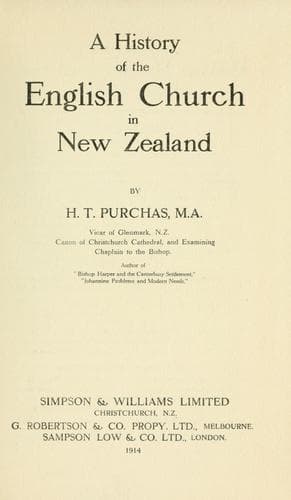
A History of the English Church in New ZealandPurchas, Henry Thomas
History
A History of the English Church in New Zealand
Purchas, Henry Thomas
Church of the Province of New Zealand -- History; New Zealand -- Church history
But the opportunity came too late. Maori Christianity had been left so
long in an unorganised and immature condition that it had begun to
develop itself on lines of its own. The march of events had brought
about a situation which was only partially foreseen, and, even if
foreseen, could hardly perhaps have been prevented. The subject is one
of peculiar difficulty, but as it has a direct bearing on problems of
to-day, an attempt must be made to elucidate its main features.
The organisation of the New Zealand Church seemed to leave no place for
the rule of the Church Missionary Society. Selwyn wished it to resign
its lands and its agents immediately into the hands of the general
synod. The Society was not quite ready to do this, but it began to
withdraw in a gradual way. It sent out few, if any, fresh missionaries
to take the places of those who had died or retired, and it began to
curtail its monetary grants. It had spent (according to Mr. Swainson's
estimate) some quarter of a million pounds on New Zealand: it might well
ask, Had not the time arrived for its funds to be employed elsewhere?
But if the white missionaries were to be allowed gradually to depart,
their places must be taken by natives of the country. Year after year
the Society was urgent in asking for the ordination of Maoris, not only
to the diaconate but also to the priesthood, in order that the Maori
Christians might have an opportunity of receiving the Holy Communion at
least once a quarter. But this the bishop would not do. He was
favourable to such a policy in the abstract, but he and the missionaries
themselves were so much impressed with the educational and social
deficiencies of even the best of the Maori converts, that they shrank
from their admission to Holy Orders. Selwyn had hoped that St. John's
College would have supplied him with men of higher education and more
civilised habits, but his expectations had been dashed by the dispersion
of 1853, and his confidence was slow to spring again.
On his return from England, he had opened a theological college for
Maoris at Parnell, where the married students might live in separate
cottages, and where they might have the benefit of the freely-given
instructions of Sir William Martin. But none of the candidates were
considered fit for Holy Orders, and up to 1860 the Bishop had ordained
but one deacon beside Rota Waitoa. If it had not been for another small
college which was begun by the Rev. W. L. Williams at Waerenga-a-hika,
and which enabled Bishop Williams, soon after his consecration, to
ordain six Maoris to the diaconate, the number of native clergy at the
opening of this period would have been small indeed.
Public-domain text, read in full here on John Shaqi.
Reviews
Reviews
No reviews yet
Be the first to share your thoughts on this work.
Elsewhere in the archive
Join the Discussion
Join the discussion
Sign in to leave a comment or review.
Sign InorCreate an account