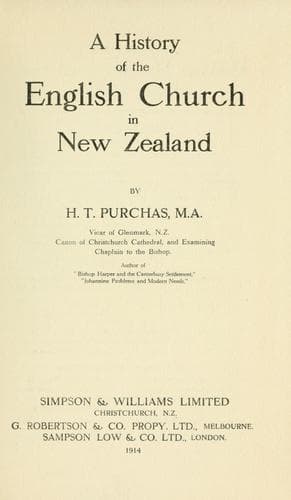
A History of the English Church in New ZealandPurchas, Henry Thomas
History
A History of the English Church in New Zealand
Purchas, Henry Thomas
Church of the Province of New Zealand -- History; New Zealand -- Church history
The necessity for more ordinations was the chief reason why the Church
Missionary Society so earnestly advocated an increase of bishops. The
establishment of the diocese of Waiapu certainly justified their hope to
a large extent, for not only did Bishop Williams admit a number of
Maoris to the ministry, but his example encouraged Selwyn himself to go
forward more boldly. His reluctance was due partly to sad experience,
partly to his own high ideals; and it would seem to afford another
instance of the truth which his career so often exemplified, "The best
is the enemy of the good." Some of the men who were to play leading
parts in the coming time were among those whom his strictness rejected.
Chief among these was that Tamihana Tarapipipi who appeared before us in
an earlier chapter. From the light-hearted youthfulness of the "bonnet"
episode, this young son of the great Waharoa had passed into a grave and
thoughtful manhood. After his father's death, his ability had led to his
being elected chief instead of his elder brother. Together with a strong
desire for knowledge there was a certain _dourness_ in Tamihana's
nature, and when he applied for admission to St. John's College, a
question is said to have arisen about smoking. The rules of the
institution prohibited this pleasant vice, and Tamihana would not give
up his pipe. Strange to think of the tremendous consequences which
flowed from that simple refusal!
Thrown back upon himself, and seeing no teacher but Archdeacon Brown,
who visited Matamata from time to time, the young thinker formed his
ideals alone. Experience soon taught him the necessity of _law_.
Loose-living and dishonest pakehas brought disease and trouble among his
people, while the old authority of the chiefs was weakening day by day.
The Old Testament offered laws which seemed framed for his own case,
and, in studying his Bible, Tamihana was struck with the important part
which was played by the _nationalism_ of the Chosen People. One verse in
particular took his attention: "Thou shalt in any wise set him king over
thee, whom the Lord thy God shall choose; one from among thy brethren
shalt thou set king over thee: thou mayest not set a stranger over thee,
which is not thy brother."--(Deut. xvii. 15.) Here, surely, was divine
sanction for the principle of nationalism and of kingship: might not the
cure for the woes of his race be found in a unified State under an
elected king of their own blood?
Public-domain text, read in full here on John Shaqi.
Reviews
Reviews
No reviews yet
Be the first to share your thoughts on this work.
Elsewhere in the archive
Join the Discussion
Join the discussion
Sign in to leave a comment or review.
Sign InorCreate an account