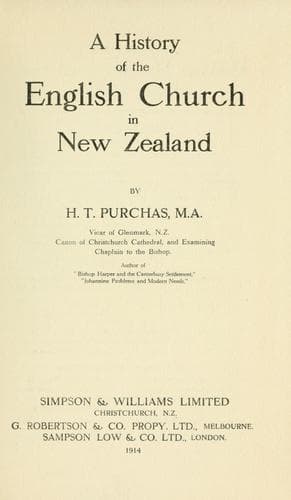
A History of the English Church in New ZealandPurchas, Henry Thomas
History
A History of the English Church in New Zealand
Purchas, Henry Thomas
Church of the Province of New Zealand -- History; New Zealand -- Church history
The beginning of the year 1860 found the king movement still friendly to
the British rule. Its influence did not extend much beyond the Waikato
country, and it was discountenanced by the tribes who lived under the
influence of Henry Williams in the north, William Williams in the east,
and of Hadfield and Taylor in the south-west. Hadfield's staunch ally,
Wiremu Kingi te Rangitaake, had, in 1848, carried his tribe back to
Taranaki, where his ancestral possessions lay, and he too kept aloof
from the movement. This chief, upon whom was to turn the future course
of events, still stood forth as a champion of the white man; and to him
New Plymouth was indebted in 1851, as Wellington had been in 1843 and
1846, for preservation from hostile attack.
Yet this was the man whom the Government now drove into opposition and
rebellion. What were his crimes that he should be so treated? In the
first place he and his tribe owned the beautiful Waitara lands which lay
close to New Plymouth, and a Naboth is always open to the old charge,
"Thou didst blaspheme God and the king." Governor Gore-Browne, upon whom
lay the direct responsibility in native matters, was an honourable man
and the brother of a highly-respected English bishop; but, Ahab-like, he
was brought to regard Te Rangitaake as a "rebel" and "an infamous
character." And who was the Jezebel in this case? The Government of the
day had much to do with the governor's decision, yet the Stafford
ministry is looked upon as the ablest and not the least upright that has
occupied the treasury benches in New Zealand. These ministers also (it
is said) had been misled. By whom? The blame is laid upon the land
commissioner, Mr. Parris, whose later reports were certainly very
misleading. Yet Parris began with a desire to be fair to all parties. He
also succumbed to outside pressure. If we enquire further, we come upon
the ugly serpent of sectarian jealousy. Taranaki was in the Wesleyan
sphere of influence: Te Rangitaake was a churchman. For the crime of
belonging to the Church of England he incurred the violent enmity of a
certain Wesleyan minister, who had never forgiven Bishop Selwyn for
refusing to allow him to sign a church burial register. Yet this
minister thought himself in the right, and could at least point to a
murder which had been committed, not by Rangitaake himself, but by
another Maori with whom this chief had formed an alliance. Who can
judge in such a case, especially when the tangled skein is still further
complicated by the action of an astute Maori whose affections had been
wounded by a damsel who deserted him in order to become the
daughter-in-law of Te Rangitaake? But it is no pleasant thought that the
decision to seize the Waitara was made by the Government in Auckland
during the very days when the first General Synod was sitting in
Wellington, and that amongst the men who thus forced on an unjust and
unholy war were at least two who had sat in the Taurarua Conference and
Public-domain text, read in full here on John Shaqi.
Reviews
Reviews
No reviews yet
Be the first to share your thoughts on this work.
Elsewhere in the archive
Join the Discussion
Join the discussion
Sign in to leave a comment or review.
Sign InorCreate an account