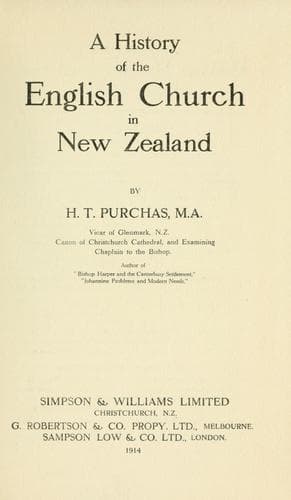
A History of the English Church in New ZealandPurchas, Henry Thomas
History
A History of the English Church in New Zealand
Purchas, Henry Thomas
Church of the Province of New Zealand -- History; New Zealand -- Church history
The ideas which were thus working in the young chief's mind were forced
into active expression by the treatment he received from those in
authority. Early in 1857 he visited Auckland, with the object of making
an appeal to the governor for good government among the Maoris. Instead
of a welcome, he received a snub from the high officials, who scornfully
advised him to go home and help himself. This rebuff drove him to
action. Sending messages far and wide, he convened a great assembly of
the inland tribes at Rangiaohia in the Waikato. The concourse afterwards
moved to Ihumatao on the shores of the Manukau, and within a few miles
of Auckland, where the conference was at that very time drafting the
church constitution. The one gathering consisted of highly educated
clergy and lawyers, the other of unlettered or self-taught Maoris; but
the object of both gatherings was the same, and so were the principles
which both professed. A Christian law was the object of them both.
Tamihana would not allow himself to be put forward as king: he proposed
for that honour the aged Waikato chief, Te Wherowhero or Potatau; but
he, as king-maker, was the life and soul of the movement. The kingship
thus set up was a sorry enough thing in outward appearance, but its flag
bore upon it the Cross of the Redeemer; its inauguration at Ngaruawahia
(in 1858) was accompanied with prayers and hymns; its object was to bar
out intoxicating liquors from the inland tribes, and to keep them from
unwholesome contact with the white man and his ways. As Marsden had
tried to found a Christian community at Rangihoua, Selwyn at St. John's,
and Godley in Canterbury, so Tamihana attempted to set up a Christian
State in the interior of the North Island.
It is sad to think that he did not meet with more sympathy from the
heads of Church and State. "The members of the Government in Auckland,"
wrote Sir John Gorst, "did not like Te Waharoa [Tamihana]. Few Europeans
knew him personally, and it was the fashion to believe him insincere."
At a preliminary meeting at Taupo, the Rev. T. Grace did indeed join in
the proceedings, but the colonial government soon moved the governor to
petition the C.M.S. for the missionary's removal. Bishop Selwyn left the
Taurarua Conference to oppose the king movement at Ihumatao. The one man
who saw it in a favourable light was Sir William Martin. To him it was
"not an enemy to be crushed, but a god-send to be welcomed." The
governor, Colonel Gore-Browne, was weak; but he felt that if he could
have Sir William Martin and Bishop Selwyn on his council for native
affairs, he might be able to walk uprightly. His proposal, however, was
declared "inadmissible," and the well-meaning governor was soon hurried
into a policy from which he at first had shrunk.
Public-domain text, read in full here on John Shaqi.
Reviews
Reviews
No reviews yet
Be the first to share your thoughts on this work.
Elsewhere in the archive
Join the Discussion
Join the discussion
Sign in to leave a comment or review.
Sign InorCreate an account