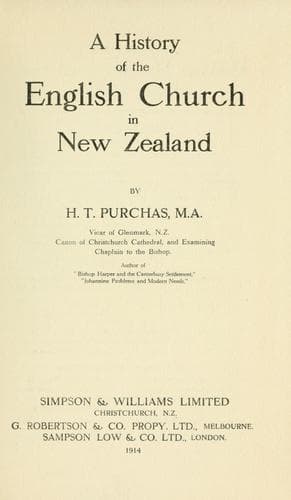
A History of the English Church in New ZealandPurchas, Henry Thomas
History
A History of the English Church in New Zealand
Purchas, Henry Thomas
Church of the Province of New Zealand -- History; New Zealand -- Church history
The latter part of 1861 saw a temporary improvement in the situation.
War was for the time suspended. The Stafford ministry were driven from
office by the vote of one of their friends, who felt the injustice of
their war policy, and--most important of all--the weak governor was
removed, and Sir George Grey sent back to take his place. Past suffering
did not prevent Henry Williams and his friends from welcoming one who,
with all his faults, was a real lover of the native race; and the
governor soon showed that he had not forgotten the mistakes he had
formerly made. One of his first acts was to go off by himself to Otaki,
and there to spend a day or two with Hadfield--son-in-law to Henry
Williams. "Of course," writes the latter, "they were agreed upon all
points." Somewhat later he called upon the patriarch himself at
Pakaraka, and consulted with him as to the best means of bringing peace
to the land. With generous trustfulness Henry Williams wrote, "I have
every confidence in Sir George, but he is in want of men to carry out
his views."
The period from October, 1861, to May, 1863, is thus interesting, as
being the last occasion in our history when it can be said that the
voice of the Church was really effective in guiding the policy of the
country. The indignant protests of Selwyn, Hadfield, and Martin had
taken effect; an enquiry into the Waitara case proved the illegality of
the Government's action. The new governor tried to establish a system
of local self-government among the Maoris, and to atone for the misdeeds
of the past. Henry Williams described the situation with characteristic
bluntness: "Of the feeling of the old ministry and their partisans,
there was no mistake: 'Hang the missionaries and bishops for having
caused the rebellion.' These persons are now so still and quiet you may
hear a pin drop, even in the bush.... Nothing is now heard but 'the dear
Maoris; who would hurt a hair of their heads?'"
The brief period of peace in the north brought troubles of its own to
Bishop Selwyn and the Church. The second General Synod was summoned to
meet at Nelson in February, 1862. On the day appointed for the opening
of the assembly there were not enough members to form a quorum. For
several days this deficiency continued, and the synod could not be
properly constituted. The members occupied themselves with passing
resolutions which were validated at the end of the period, when at last
a quorum was secured.
Public-domain text, read in full here on John Shaqi.
Reviews
Reviews
No reviews yet
Be the first to share your thoughts on this work.
Elsewhere in the archive
Join the Discussion
Join the discussion
Sign in to leave a comment or review.
Sign InorCreate an account