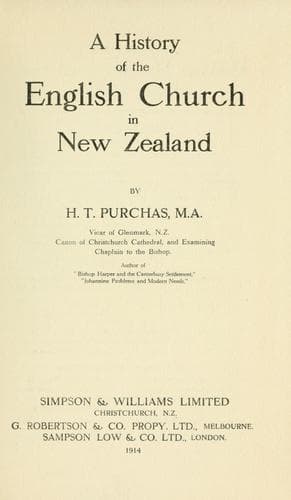
A History of the English Church in New ZealandPurchas, Henry Thomas
History
A History of the English Church in New Zealand
Purchas, Henry Thomas
Church of the Province of New Zealand -- History; New Zealand -- Church history
The chief reason for the smallness of this gathering was the attitude of
the diocese of Christchurch. This important part of the Church was in a
state of rebellion against the constitution. None of its principal
clergy had attended the synod of 1859; no representative but the bishop
came to that of 1862. Its grievances were of various kinds: it found
fault with the "property" element, and the "mutual compact" idea, and
the unalterable fundamentals, and all the other features upon which the
Auckland laity had insisted. It seemed as though the spirit of Godley
had returned in all its trenchant and uncompromising churchmanship. But
the most definite of all the Canterbury grievances arose from the claim
of the General Synod to own and administer all the church property in
the country. Bishop Selwyn had handed over to the first synod more than
seventy trust properties, which had been hitherto vested in himself as
corporation sole: he expected the diocese of Christchurch to do the
same. But this the Canterbury churchmen would never do. Rather than do
it, they resolved to secede from the Church of New Zealand, and to
reconstitute themselves on a diocesan basis. They appealed to the
primate to "throw over" the constitution altogether, and to start afresh
on what they considered more churchlike principles.
Such was the ecclesiastical situation for the next three years--1862 to
1865. The position was serious, and there was just the possibility of a
schism. But it was hardly more than a possibility. Selwyn seems not to
have disquieted himself very greatly about the matter. For there was one
saving feature in the case. Christchurch could hardly set up for itself
on a diocesan basis without its bishop; and Bishop Harper was Selwyn's
friend, and he was loyal to the constitution. The whole synod of
Christchurch might pass threatening resolutions--as it did in 1863 and
1864--but as long as Henry Harper occupied the bishop's seat they were
bound to be blocked by the episcopal veto. And before the next General
Synod the Church was to pass through such tragic occurrences that the
question at issue could no longer command the same primary and absorbing
interest.
CHAPTER XIV.
RUIN AND DESOLATION.
(1862-1868).
Our heart's consuming pain,
At sight of ruined altars, prophets slain,
And God's own ark with blood of souls defiled!
--_Keble._
Public-domain text, read in full here on John Shaqi.
Reviews
Reviews
No reviews yet
Be the first to share your thoughts on this work.
Elsewhere in the archive
Join the Discussion
Join the discussion
Sign in to leave a comment or review.
Sign InorCreate an account