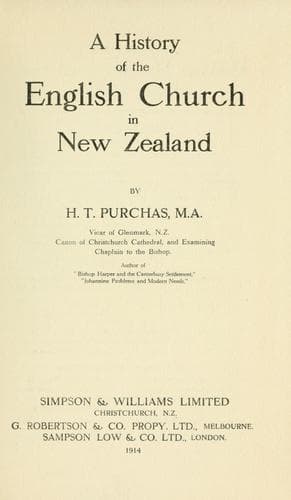
A History of the English Church in New ZealandPurchas, Henry Thomas
History
A History of the English Church in New Zealand
Purchas, Henry Thomas
Church of the Province of New Zealand -- History; New Zealand -- Church history
The armed truce which lasted from June, 1861, to May, 1863, was marked
by strenuous efforts on both sides to bring about a lasting peace. To
appreciate the gravity of the situation, it is necessary to remember
that the European settlements were still but a fringe round the coast,
while the whole of the interior of the island was occupied by the
Maoris. But that race had so dwindled away during the last half-century,
and the Europeans had poured in so fast during the last twenty years,
that the relative numbers were now not very unequal. If the Maoris had
been united, they might even yet have driven the immigrants from the
land. That they were not united in any such hostile policy was due
almost entirely to the influence of the missionaries. There would have
been no hostility at all if just and considerate treatment had been the
rule throughout.
In justification of this statement we have only to follow the action of
the king-maker, Tamihana, of the old "king," Potatau, and even of his
successor, Tawhiao. As long as he lived, old Potatau said _Amen_ at the
end of the prayer for the Queen. Even when many of the "king's"
adherents had joined the Taranaki army, which was fighting for its life
against the Imperial troops, the prayer was still offered up day by day
without curtailment, though perhaps with some misgiving, that her
majesty might be strengthened to "vanquish and overcome all her
enemies." Sir George Grey established Mr. Gorst as magistrate and
schoolmaster in the heart of the Waikato. The native authorities would
allow no one to appear as a suitor in his court, but they took an
interest in his school, and visited it from time to time.
But Taranaki still seethed with discontent, and murders sometimes
occurred. Tamihana's position became more and more difficult. He
convened a great meeting on Oct. 23, 1862, at Peria, to discuss the
Waitara and other grievances. It began with solemn evensong, and on the
following Sunday morning Tamihana himself preached an eloquent sermon
from the text, "Behold, how good and joyful a thing it is, brethren, to
dwell together in unity." In fervid language he urged the cessation of
all inter-tribal quarrels, and the unification of the race under the
king's flag. Bishop Selwyn was present, and in the afternoon preached
from the same text on the need for a still larger unity, which should
embrace both nations under the flag of the Queen. Tamihana was touched
by this appeal, and made another attempt to induce Rangitaake to submit
his claim to arbitration. The chief refused, and the king-maker was
driven to the conviction that his power was beginning to decline. It was
passing into the hands of the more violent Rewi, who longed for war with
the pakeha as keenly as some of the Taranaki settlers longed for war
with the Maori.
Public-domain text, read in full here on John Shaqi.
Reviews
Reviews
No reviews yet
Be the first to share your thoughts on this work.
Elsewhere in the archive
Join the Discussion
Join the discussion
Sign in to leave a comment or review.
Sign InorCreate an account