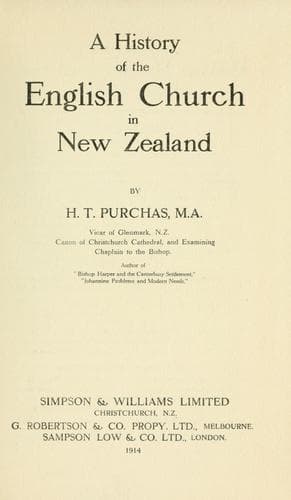
A History of the English Church in New ZealandPurchas, Henry Thomas
History
A History of the English Church in New Zealand
Purchas, Henry Thomas
Church of the Province of New Zealand -- History; New Zealand -- Church history
While recognising, however, the gallantry of the Maoris, the world has
hitherto taken little account of the high moral character of the
king-movement. A conspicuous example of this quality is afforded by the
career of Henare Wiremu Taratoa. Baptised and taught by Henry Williams,
after whom he was named, this man had been afterwards trained at St.
John's College, and had actually taken a part in the founding of the
Melanesian Mission. When at length he was pronounced unfit for the
sacred ministry on account of his impetuous disposition, he became a
teacher in the mission school at Otaki. Here he remained until 1861,
when the governor's aggressive policy determined him to cast in his lot
with his threatened countrymen. Settling in Tauranga, a place which
became the scene of military operations in 1864, he joined in the
fighting at the Gate Pa, where the Imperial troops sustained their most
severe defeat. But he had never forgotten his Christian training. On
arrival at Tauranga, he set up a "school of instruction in arithmetic
and christening." He then organised a system of councils, which
regulated both civil and religious matters. The result was that "the
people feared to do wrong, and nothing but good order prevailed." When
war broke out, his rules were strikingly humane. There must be no
ill-treatment of women or non-combatants; no soldier once hit must be
shot a second time; if an enemy were hungry he must be fed; fighting
must never begin on a Sunday (as all the British campaigns had done),
but rather on a Friday, "that being the day on which Christ was
crucified."
These rules were not vain ones with Taratoa and his men. Through the
night after the conflict at the Gate Pa, Henare tended the English
wounded, one of whom, in his dying agonies, thirsted for a drop of
water. There was none in the _pa_, nor within three miles on the Maori
side of it, but Taratoa threaded his way through the English sentries in
the darkness, and returned with a calabash of water to slake his
enemy's thirst. By the side of each wounded Englishman there was found
in the morning some small water-vessel, placed there by the Maoris
before they deserted the fort.
In spite of their success at the Gate Pa, the Maoris were soon
afterwards beaten at Te Ranga (June 21), and in this battle the humane
Taratoa was killed. Upon his body was found a little book of prayers
which he had compiled and used. It concluded with the apostolic precept
which he had obeyed at the risk of his life, "If thine enemy hunger,
feed him; if he thirst, give him drink."
Public-domain text, read in full here on John Shaqi.
Reviews
Reviews
No reviews yet
Be the first to share your thoughts on this work.
Elsewhere in the archive
Join the Discussion
Join the discussion
Sign in to leave a comment or review.
Sign InorCreate an account