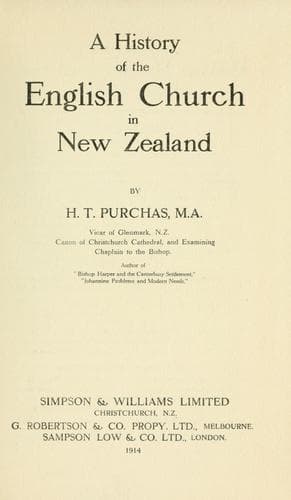
A History of the English Church in New ZealandPurchas, Henry Thomas
History
A History of the English Church in New Zealand
Purchas, Henry Thomas
Church of the Province of New Zealand -- History; New Zealand -- Church history
Taratoa's laws of war were far from being observed by his "civilised"
opponents. In sadness and shame we read of the devastation of the once
smiling Rangiaohia, and of the utter destruction, there and throughout
the country, of crops and houses.[13] Hostilities were followed up by
wholesale confiscation of the Maoris' lands--a measure which was to some
extent the real object of the war. Maddened by defeat, by the loss of
lands and homes, by hunger, and by disease which followed hunger, the
Maoris were at last ready to doubt the truth of the religion which the
white man had brought them.
[13] I have kept out of the text all mention of the burning of women
and children in a whare at this place, because one clings to the
belief that it was accidental. Englishmen don't do things like that
intentionally. But there can be no doubt that it made a deep
impression upon the Maori mind. The English general had told them
(they said) to send their women and children to Rangiaohia for safety.
They did so, and then the troops, instead of attacking their _men_,
attacked and burnt their women. The Maoris seem to have had a peculiar
horror of fire. In their most savage days they always killed their
enemies before they cooked them.
The match was soon laid to the train. An old man in Taranaki announced
that he had received the revelation of a new religion, suited to the
Maori people. Like the Arabian Mohammed, Te Ua was considered to be a
person of weak intellect; like Mohammed, he claimed to have received his
revelation from the Angel Gabriel; like the Arabian prophet again, he
put forth a mixture of Judaism[14] and heathenism which sanctioned
polygamy, and whose propagation was to be carried on by the sword. A
trifling success over a small English troop gave the necessary impetus
to the movement, and soon bands of ardent Hauhaus (as they were called)
were traversing the island, and winning over crowds of restless and
dissatisfied people. By making their listeners walk round a pole,
chanting a strange jargon in which a few Latin words can be recognised,
they mesmerised the susceptible Maoris, and gained complete control over
their minds.
[14] This is generally admitted; but Bishop Williams, who had
exceptional opportunities for studying Hauhauism, thinks that the
element of Judaism was very slight.
Public-domain text, read in full here on John Shaqi.
Reviews
Reviews
No reviews yet
Be the first to share your thoughts on this work.
Elsewhere in the archive
Join the Discussion
Join the discussion
Sign in to leave a comment or review.
Sign InorCreate an account