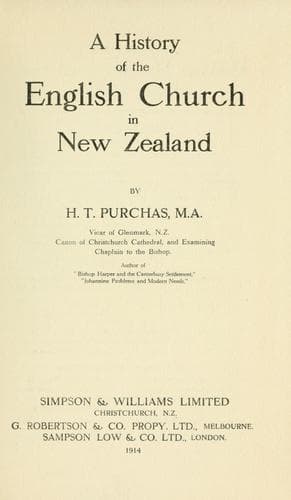
A History of the English Church in New ZealandPurchas, Henry Thomas
History
A History of the English Church in New Zealand
Purchas, Henry Thomas
Church of the Province of New Zealand -- History; New Zealand -- Church history
The attention of the Hauhaus was turned first to the south; but, at
Otaki, Hadfield's influence once more availed to save the settlement,
and to block the road to Wellington. At Wanganui, Taylor's Maoris stood
firm in their loyalty, and in a desperate battle on the island of Moutoa
drove back the enemy at fearful loss to themselves (May 14, 1864). Some
months later, however, a second attack was made on Wanganui, and the
crisis brought out the magnificent heroism of another of Selwyn's old
students, "John Williams" Hipango. There had been no rejection in his
case, but he had studied so hard by dim candlelight that his eyesight
was affected, and he was obliged with great sorrow to give up his hope
of entering the ministry. At the time of the attack he occupied a
responsible position among the Maoris, and now he took command of the
defence. The enemy sent four men to lie in ambush and kill him, but
Hipango caught them, fed them, and sent them away unhurt. The next night
ten men were sent for the same purpose; they too were caught, and they
too were released. "I will not," said Hipango, "be the first to shed
blood." Next day, Feb. 23rd, 1865, the Hauhaus came forward in open
attack. They were completely defeated, but in the hour of victory a ball
struck John in the chest. He was buried at Wanganui with military
honours, white men carrying their deliverer's body to the grave.
In the same month a band of the fanatics reached Opotiki in the Bay of
Plenty. The mission station at this place was now under the charge of
Carl Sylvius Volkner, a fair-haired, blue-eyed German, who had been
ordained by Bishop Williams in 1860. He had acquired great influence
over the people, and had built a church and a school; but so threatening
had the aspect of things become that he had taken his young wife for
safety to Auckland, as Mr. Grace had done his family from Taupo. The two
missionaries returned in a schooner on the first of March to Opotiki,
bringing food and medicines for the sick and starving people. Their
vessel was descried just at the time when the Hauhaus were indulging in
one of their wild orgiastic dances. Their leader, Kereopa, announced
that their god demanded a victim. On arrival in the river the schooner
was seized by the excited crowd. After several hours of anxious
suspense, the missionaries were ordered on shore, where, amidst taunts
and revilings, they were conducted to a small house, there to await
their fate.
Public-domain text, read in full here on John Shaqi.
Reviews
Reviews
No reviews yet
Be the first to share your thoughts on this work.
Elsewhere in the archive
Join the Discussion
Join the discussion
Sign in to leave a comment or review.
Sign InorCreate an account