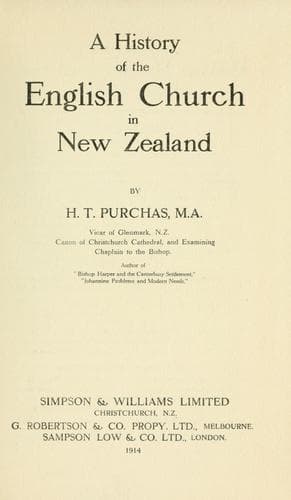
A History of the English Church in New ZealandPurchas, Henry Thomas
History
A History of the English Church in New Zealand
Purchas, Henry Thomas
Church of the Province of New Zealand -- History; New Zealand -- Church history
At the end of the same month, April, 1865, the time arrived for the
General Synod to decide whether the Church in New Zealand should remain
united, or be divided into a northern and a southern organisation. The
synod was held in Christchurch, where the centre of disaffection lay.
Far removed as it was from the scene of the late troubles, the synod yet
met under the shadow of Volkner's death. Bishop Williams, too, with the
missionaries Clarke and Maunsell, had felt the heavy hand of war. It was
no time to fight over non-essentials. Canterbury was strong in its
peaceful prosperity: from the loft where the council sat the members
might look down on a scene of busy labour on the foundations of a great
cathedral, while another solid stone church (St. John Baptist) was
rising in a neighbouring square. But its lofty pretensions to local
independence could not be sustained. Archdeacon Wilson could find no
seconder for his secession motion. Men of wisdom, like Bishop Patteson
and Sir William Martin, made their influence felt on the side of peace.
The primate maintained from the outset that Christchurch was at liberty
to keep its endowments in its own hands, and its right to do so was now
definitely affirmed by the synod. The constitution also was improved by
some small changes in the direction desired by Canterbury churchmen.
But, on the whole, there was little change. Canterbury came down from
the "cloud-cuckoo-land" in which Selwyn twitted her with dwelling. Both
sides gained a better understanding of one another, and agreed to stand
together on the ground of the original constitution.
Amongst the Maoris also the martyrdom of Volkner had its influence.
Sickened by the brutality of men whom he had hitherto unwillingly
tolerated, Tamihana came to the British general and swore allegiance to
the Government. "Let the law of the queen," said he, "be the law of the
king, to be a protection to us all for ever and for ever." But his
patriotic heart was broken, and during the next year he fell into a
rapid decline. Still holding himself somewhat aloof from the white
clergy, he was upheld by the loving ministrations of his own people. As
they bore him by easy stages to his place of death, they offered this
prayer at every fresh removal: "Almighty God, we beseech Thee give
strength to Wiremu Tamihana whilst we remove him from this place. If it
please Thee, restore him again to perfect strength; if that is not Thy
will, take him, we beseech Thee, to heaven." He died with his deeply
studied Bible in his hand, his last words being a repetition of his old
watchword--RELIGION, LOVE, and LAW.
Public-domain text, read in full here on John Shaqi.
Reviews
Reviews
No reviews yet
Be the first to share your thoughts on this work.
Elsewhere in the archive
Join the Discussion
Join the discussion
Sign in to leave a comment or review.
Sign InorCreate an account