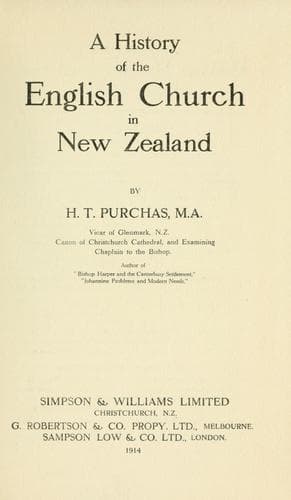
A History of the English Church in New ZealandPurchas, Henry Thomas
History
A History of the English Church in New Zealand
Purchas, Henry Thomas
Church of the Province of New Zealand -- History; New Zealand -- Church history
For two or three years longer the embers of war continued to blaze up
here and there. In 1867 an inter-tribal quarrel arose in the hitherto
peaceful north. A few lives were lost, and a day was fixed for a pitched
battle near Pakaraka--the opposing forces numbering nearly 600 men. No
such muster had been seen in that region since the time of Heke's war,
twenty years before. But on the morning of the battle day a message went
round both the camps, which stilled the passions of the combatants: "Te
Wiremu" was dead (July 16, 1867). The outbreak of strife had indeed
hastened the end. Instead of fighting out their quarrel, the leaders
sorrowfully made their way to take part in the old peace-maker's
funeral, and when they returned they made peace with one another. Thus
appropriately died this greatest of New Zealand missionaries. As a chief
said at the unveiling of the monument which the Maori Church erected to
his memory at Paihia: "This island was a very hard stone, and it was
Archdeacon Williams who broke it."
Within a few days of Henry Williams' death, Bishop Selwyn sailed for
England, to attend the first meeting of bishops at Lambeth. While in
England he was offered by the prime minister the bishopric of Lichfield.
Without any long delay, he sent his answer declining the proposal, and
the see was offered to another. This decision reveals, as no other act
could do, the magnificent heroism of the man. He had come to New Zealand
twenty-five years before with youthful ambitions of building a new
Jerusalem at the end of the earth. He had met with much success, but now
his work seemed to be destroyed. All he could hope to do was "to sit
amid the ruins of the spiritual temple which he had been allowed to
build, and to trace out new foundations on which to build once more." He
had begun his life with visions of restoring to the faith of Christ the
regions which had been desolated by Islam: he had lived to see his own
once loyal and Christian diocese swept by a propaganda compared to which
even Islam is a noble creed. The task which remained to him in New
Zealand was far harder than that which confronted him when he began his
episcopate. Yet then, he had the buoyancy of youth, and he had offers of
assistance from other youthful and sanguine spirits. Now, he was nearing
the age of 60, and there were no eager volunteers to help. No Pattesons
nor Whyteheads nor Abrahams had come out to him during the last decade:
indeed he had found it hard to secure any new clergy at all. His own
stipend had been cut down to less than half its original amount, and he
could with difficulty raise any funds for his diocese. To refuse an
English bishopric with its honours and emoluments, its seat in the House
of Lords, its great opportunities for influencing the policy of the
Church, and for playing a noble part in the eyes of the nation: surely
this was a sacrifice of the rarest and highest kind. Yet, to his eternal
honour, George Augustus Selwyn made this "great refusal."
Public-domain text, read in full here on John Shaqi.
Reviews
Reviews
No reviews yet
Be the first to share your thoughts on this work.
Elsewhere in the archive
Join the Discussion
Join the discussion
Sign in to leave a comment or review.
Sign InorCreate an account