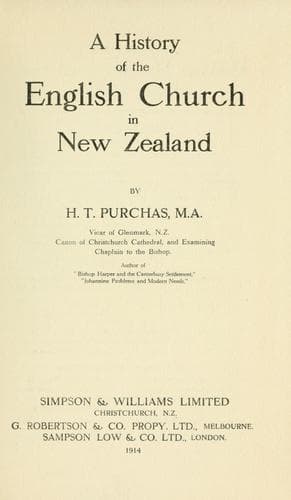
A History of the English Church in New ZealandPurchas, Henry Thomas
History
A History of the English Church in New Zealand
Purchas, Henry Thomas
Church of the Province of New Zealand -- History; New Zealand -- Church history
The matter, however, was not to end there. At least two other clergymen
refused Lichfield, and then the offer came round again to Selwyn. This
time it was conveyed through the Archbishop of Canterbury, and
consequently it carried more weight. Still he hesitated. Friends drew
attention to the miserable stipend he was now receiving. "If I have to
live on _pipis_ and potatoes," said the bishop, "I would go back."
Lastly, the Queen sent for him. Taking both his hands in hers, she said,
"Dr. Selwyn, I want you to go to Lichfield." This was conclusive, and
the Bishop of New Zealand was soon installed in the old palace in the
Lichfield Cathedral close. He came back to New Zealand in the following
year to hand over the finances of his diocese, and to preside at a last
general synod, but it was as one whose work on the old ground was done.
He left the country finally at the close of the synod (October 20,
1868), amidst the affectionate farewells of all classes, and so passed
from the possession, though not from the memory, of the New Zealand
Church.
His departure marks the close of the formative period of our history.
Henry Williams had just received his call; Sir George Grey, who came
almost with the bishop, and with whom he co-operated in so many ways,
was to leave the country a few months later. He was the last governor
who governed, as Selwyn was the last (as well as the first) Bishop of
New Zealand, and the only bishop who exercised personal authority before
the organisation of constitution or synod.
What manner of man he was may be gathered to some extent from the
foregoing pages, though many of his good deeds have necessarily been
left unrecorded. "He was no common man," writes Mr. Gisborne, "and his
mind was cast in no common mould. His great characteristics were force
of will, zeal, eloquence, courage, and moral heroism. His main defect
was an impetuous temper, which occasionally made him dictatorial and
indiscreet." To the same effect wrote Mr. Carleton, after a reference to
his "lust of power": "Able, unselfish, enthusiastic, and devoted, we
shall not readily meet with his like again." These testimonies are
quoted as being those of politicians, and, in the case of Carleton, of a
keen opponent. The church historian, whilst not ignoring the faults
which the bishop, like other strong natures, possessed, may well go
somewhat further than the man of the world. He is fain to recognise the
nobleness of the bishop's ideals, the width of his learning, the
soundness of his churchmanship, the statesmanlike grasp with which he
confronted the difficulties and dangers of an unfamiliar situation. The
old autocratic temper still remained, as the Church of New Zealand was
yet to realise; but we may mark with reverent awe the growing humility,
the increasing tolerance, the chastened piety which the stern discipline
of life had wrought in this strong and impetuous character.
Third Period.
[Illustration: ST. JOHN'S CHURCH, INVERCARGILL.]
CHAPTER XV.
Public-domain text, read in full here on John Shaqi.
Reviews
Reviews
No reviews yet
Be the first to share your thoughts on this work.
Elsewhere in the archive
Join the Discussion
Join the discussion
Sign in to leave a comment or review.
Sign InorCreate an account