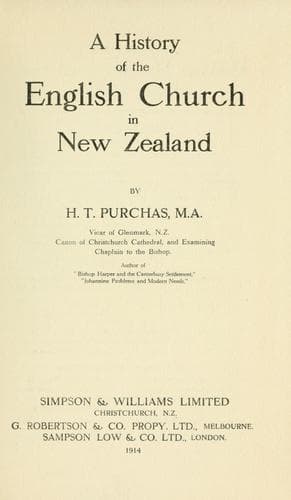
A History of the English Church in New ZealandPurchas, Henry Thomas
History
A History of the English Church in New Zealand
Purchas, Henry Thomas
Church of the Province of New Zealand -- History; New Zealand -- Church history
But, however it might be with the immigrant, the Maori remained a
religious being. Strange, fanatical, repulsive, as might be the forms
which his devotion took, he was still a believer in a world of spirit.
Selwyn had hoped that this ingrained religiousness would have acted for
good on the colonist. Of such influence there is little trace. The
drawing together which might undoubtedly be seen before the war, had
given place to a movement in the opposite direction. Here again Selwyn's
departure was significant. There never came another who looked upon
Maori and pakeha with the same equal and comprehensive love.
An incident from the days before the war may serve to show what, under
happier circumstances, the Maori might have done for his European
brother:
Sir George Grey, Bishop Selwyn, and an English visitor were travelling
along the east coast, near Ahuriri. In the course of the day they had
been talking to the natives about the duty of reserving certain of their
lands as educational grants for the benefit of their children and of
posterity. In the middle of the night they were woke up in their tent by
a deputation of these natives calling to Sir George Grey, and asking him
whether he himself acted upon the plan he recommended to them, and
whether he gave tithes, or any portion of his worldly goods, to the
Church of God. The governor was bound to admit that he had not done so
in the past; but undertook to do better for the future. The result was
that he bought and gave a piece of land in Wellington as a site for a
church. Bishop Selwyn added an adjoining section, and the English
visitor[17] still another; and thus the diocese acquired what it had
long sought for in vain--a central site for its cathedral church,
diocesan offices, and bishop's residence.
[17] This was the Hon. A. G. Tollemache, who afterwards added another
section of city land for an episcopal endowment.
The diocese in which the two races are brought into closest and most
equal relations is, of course, that of Waiapu. The reconstruction of
this shattered portion of the Church was brought about indirectly by the
same zeal on the part of Governor Grey for securing educational reserves
for the Maoris.
We have seen that Bishop Williams was driven from his home in 1865, and
compelled to take refuge with his brother in the north. For seven years
Waiapu was left without a synod, and, in one sense, it never received
its bishop back at all. Some months after the bishop's departure, his
house at Waerenga-a-hika (near Gisborne) was the scene of a fierce
battle. The Hauhaus held the adjoining _pa_, and the bishop's house was
used as the fortress of the British troops. After seven days' siege the
_pa_ was captured, but the episcopal residence and the college were in
ruins. The bishop remained for two years in exile, and his restoration
was at last brought about in an unexpected way.
Public-domain text, read in full here on John Shaqi.
Reviews
Reviews
No reviews yet
Be the first to share your thoughts on this work.
Elsewhere in the archive
Join the Discussion
Join the discussion
Sign in to leave a comment or review.
Sign InorCreate an account