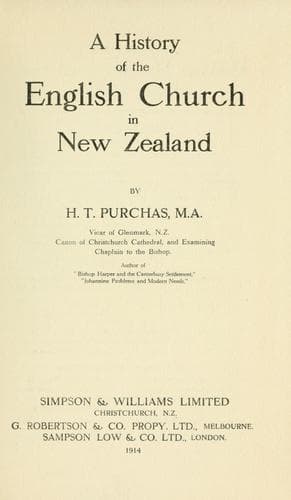
A History of the English Church in New ZealandPurchas, Henry Thomas
History
A History of the English Church in New Zealand
Purchas, Henry Thomas
Church of the Province of New Zealand -- History; New Zealand -- Church history
In the same year (1853) as that in which he received the shock of the
Maori's midnight question, Sir George Grey induced the Rev. Samuel
Williams to leave the school which he was carrying on for Hadfield at
Otaki, and to move across the island to Hawke's Bay. Here he gave him
4,000 acres at Te Aute for a Maori school, and the natives of the
district gave a similar amount. The country was covered with bush and
fern, the land yielded no rental, and there were no funds for the
school. At last, Samuel Williams took the work into his own hands. In
order to create a school he must begin by farming the land. After
several years of experiment and of anxious labour, he succeeded not only
in bringing the school estate to a condition of productiveness, but in
giving a valuable object lesson to other settlers. Now he could begin
the school; but who was to help him in the work of instruction? His
thoughts turned to his uncle, the dispossessed bishop, who, on his part,
was seeking some new base from which to begin his work over again. In
response to his nephew, the bishop brought his family to Hawke's Bay in
1867, and was at once prevailed upon by the people of Napier to take
charge of their vacant parish. Bishop Abraham, of Wellington, in whose
diocese Hawke's Bay was situated, gladly availed himself of the
episcopal visitor for work among the Maoris. The position was a strange
one, for here was a bishop living outside his own diocese and working in
an adjoining one. The general synod of 1868, however, set matters right
by transferring Hawke's Bay to the diocese of Waiapu. Bishop Williams
made Napier his new headquarters, and the diocese took the bilingual
character which it bears to-day.
Not so soon or so happily settled was another trouble which took its
rise in the same siege of Waerenga-a-hika in 1865.
The fight at this place was well-nigh the end of Hauhauism, for the
British bullets laid low many a misguided enthusiast who relied on the
prophet's promise of invulnerability. But amongst the Maoris who fought
on the British side was one Te Kooti, who was accused--unjustly, as was
afterwards proved--of traitorous communication with the enemy. For some
days he was kept a prisoner in the guard-room in the bishop's house; he
was then deported with the Hauhau prisoners to Chatham Island. They were
promised a safe return in two years on condition of good behaviour, and,
by the testimony of all witnesses, their behaviour was exemplary.
Public-domain text, read in full here on John Shaqi.
Reviews
Reviews
No reviews yet
Be the first to share your thoughts on this work.
Elsewhere in the archive
Join the Discussion
Join the discussion
Sign in to leave a comment or review.
Sign InorCreate an account