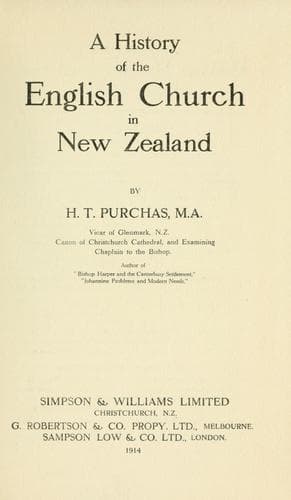
A History of the English Church in New ZealandPurchas, Henry Thomas
History
A History of the English Church in New Zealand
Purchas, Henry Thomas
Church of the Province of New Zealand -- History; New Zealand -- Church history
His doctrines are still held by many of the Maoris in the Bay of Plenty
and elsewhere. They are called "_Ringa-tu_," from the practice of
holding up the hand at the conclusion of their prayers. They observe the
seventh day as their Sabbath. Some have introduced the name of our
Saviour into their worship, but "Jesus Christ is to them a name and
nothing more, and their children grow up in heathen ignorance."
The phenomena of Hauhauism and of the _Ringa-tu_ certainly suggest the
question whether it was wise to translate the whole of the Old Testament
into the Maori language. It can hardly be a mere coincidence that
Maunsell's translation was finished and published in 1856, shortly
before the troubles began. Tamihana, it is true, is said to have read
his Bible in English, but his followers must have been for the most part
dependent on the Maori version. Even the Hauhaus, though professing to
abjure the white man's religion altogether, were dependent on the white
man's book. "From the Bible," wrote Lady Martin, "which was their only
literature, they got their phraseology. The men who excited and guided
them were prophets; Jehovah was to fight for them; the arm of the Lord
and the sword of the Lord were on their side, to drive the English into
the sea."
Through the providence of God, the people of Israel were led step by
step from the rude violence of the days of Joshua and the Judges to the
spiritual religion of the prophets and the revelation of love in Jesus
Christ. With the Maori the process was reversed. The Old Testament was
kept back to the last. Having begun in the spirit, they were sought to
be made perfect in the flesh. What wonder if, when they took into
account the whole course of the white man's dealings with them, they
should have become convinced that the missionaries were sent before to
tame their spirits so that the colonists might follow and take their
land?
The condition even of the loyal Maoris after the war was an unhappy one.
Bishop Selwyn always spoke with thankfulness of the fact that not one of
the native priests or deacons had faltered in his attachment to the
Christian faith or to the British crown. But, with the exception of Heta
Terawhiti, they were unable to penetrate into the King Country, or to do
much in any way to rouse their countrymen to fresh exertion. Nor were
the white missionaries more successful. They were now elderly men, and
they seem not to have had the heart to make fresh efforts. Morgan had
died in the year 1865; Ashwell returned to his station after some years;
but Dr. Maunsell remained in Auckland as incumbent of Parnell. One or
two efforts were made to effect an entrance into the King Country, but
before proceeding far the missionary was always turned back. Those
Maoris who had fought on the British side were seldom the better for
their contact with the white man. Drunkenness became prevalent among
them, and altogether the after-war period presents a sad picture of
apathy and decline.
Public-domain text, read in full here on John Shaqi.
Reviews
Reviews
No reviews yet
Be the first to share your thoughts on this work.
Elsewhere in the archive
Join the Discussion
Join the discussion
Sign in to leave a comment or review.
Sign InorCreate an account