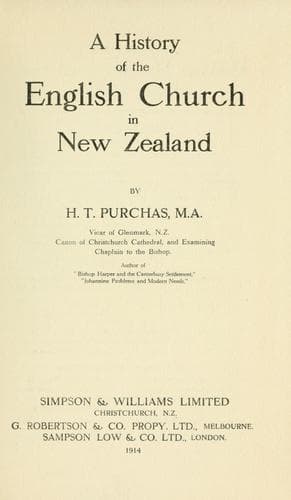
A History of the English Church in New ZealandPurchas, Henry Thomas
History
A History of the English Church in New Zealand
Purchas, Henry Thomas
Church of the Province of New Zealand -- History; New Zealand -- Church history
Nor can it be said that up to the present time there has been any
general revival. But cheering symptoms may be noted. The King Country,
which long remained closed to the missionaries and to all Europeans, is
now open in every part. The old "kingship" is still existent, but it is
now perfectly orthodox. At the installation of the present holder of the
title (in 1912), the Maori clergy were present in their surplices; hymns
such as "Onward Christian Soldiers" were sung; and a descendant of
Tamihana "anointed" the young chief by placing the open Bible upon his
head. North of Auckland, and on the north-east coast, a steady pastoral
work has been carried on continuously by native clergy and layreaders
under the supervision of English archdeacons. On the Wanganui River,
numbers of lapsed Maoris have returned to the Church; while in the Bay
of Plenty and around Rotorua, a great improvement has been manifest
during the last few years--an improvement largely due to the efforts of
Goodyear, Bennett, and the native clergy.
But, on the whole, the Maori of to-day is difficult to reach. He has
seen too much to be easily moved to wonder. When Marsden rode his horse
along the beach at Oihi, the natives were struck with admiration at the
novel spectacle. To-day the missionary, mounted perhaps on a humble
bicycle, may meet his Maori parishioner driving the most expensive kind
of motor car. Kendall acquired great influence over the native mind by
exhibiting a barrel organ which he had brought from England: if he
had arrived to-day he might have been invited to listen to a selection
of modern airs from a Maori-owned gramophone.
[Illustration: ST. LUKE'S, OAMARU.]
The chief hope lies in the education of the young. The government
primary schools are doing much throughout the country, many of their
teachers being trained in religious high schools and colleges. Of these
the Church has a fair number. St. Stephen's School at Parnell, Auckland,
still carries on the work begun by Selwyn at St. John's. It is a
technical school with 60 boarders. A similar institution for girls is
the Queen Victoria College in the same city.
The Te Aute estate in Hawke's Bay, so successfully managed by Archdeacon
Samuel Williams, supports a secondary boarding school and college, which
exert a great influence among the high-born Maoris. From this
institution has sprung the "Young Maori" party, which has done much to
raise the standard of living in the _pas_. A kindred institution,
supported by the same endowment, is the Hukarere School for girls at
Napier. This is perhaps the most influential of all the agencies for the
advancement of the Maori.
Public-domain text, read in full here on John Shaqi.
Reviews
Reviews
No reviews yet
Be the first to share your thoughts on this work.
Elsewhere in the archive
Join the Discussion
Join the discussion
Sign in to leave a comment or review.
Sign InorCreate an account