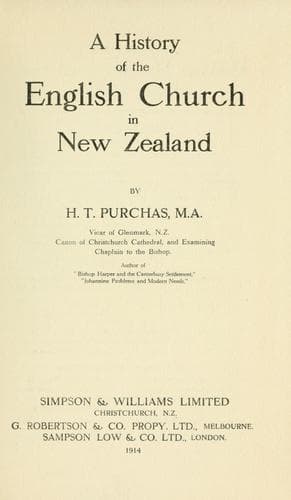
A History of the English Church in New ZealandPurchas, Henry Thomas
History
A History of the English Church in New Zealand
Purchas, Henry Thomas
Church of the Province of New Zealand -- History; New Zealand -- Church history
When Bishop Harper was appointed to the see of Christchurch in 1856,
Otago and Southland formed part of his diocese, and his long journeys on
horseback through these districts were among the most arduous and
adventurous labours of his episcopate. He retained them until June 4th,
1871, when, as primate, he consecrated the Rev. S. T. Neville to the
bishopric of Dunedin; and on the same day, as bishop, resigned these
southern portions of his original diocese.
But there was another claimant to the office--one, moreover, who was
considered by the English episcopate to be its rightful occupant. How
could such an extraordinary situation have arisen? The blame must lie
(as Bishop W. L. Williams points out) somewhere between Bishop Selwyn
and the Archbishop of Canterbury (Dr. Longley). Something that was
written by the former in 1865 caused the latter to select, and
eventually to consecrate, one of his clergy, the Rev. H. L. Jenner, for
a diocese which was not yet formed, and for a people who always
protested against his appointment.
A mystery still hangs over the precise motives which actuated the
archbishop. But perhaps they can be conjectured with a fair degree of
probability. The letter upon which he acted arrived in England not long
after the news of Volkner's murder. It was hard for those who had never
left England to realise the difference between the Hauhau-ridden north
and the law-abiding south of such a distant country as New Zealand. The
archbishop might well think that his best course was to send out another
bishop as soon as possible, without waiting for compliance with
constitutional formalities. Accordingly he consecrated the Rev. H. L.
Jenner "to be a bishop in New Zealand"--leaving the local authorities to
determine the exact locality of his labours.
But no such ignorance can be pleaded for Bishop Selwyn. When he wrote
the letter to the Primate of All England he was fresh from the great
synod of 1865, where the whole constitution had been revised, and the
procedure in the election of a bishop made more clear and precise. How
could he violate a law which he himself had just subscribed? The only
answer is that he did not violate it. His letter can have contained no
such request as the archbishop imagined. Selwyn himself was as much
startled as anyone, when he found what his letter had led to. But
obedience to authority was the ruling principle of his life, and, like
another Strafford, he determined to take upon himself the whole
responsibility for what was done. It was doubtless an act of heroism,
but a simple insistence upon the plain truth would have prevented much
misunderstanding, and saved the New Zealand Church some years of
trouble.
Public-domain text, read in full here on John Shaqi.
Reviews
Reviews
No reviews yet
Be the first to share your thoughts on this work.
Elsewhere in the archive
Join the Discussion
Join the discussion
Sign in to leave a comment or review.
Sign InorCreate an account