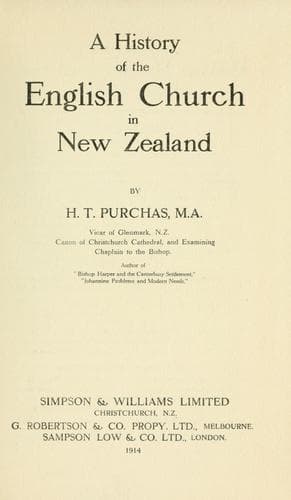
A History of the English Church in New ZealandPurchas, Henry Thomas
History
A History of the English Church in New Zealand
Purchas, Henry Thomas
Church of the Province of New Zealand -- History; New Zealand -- Church history
The old Waerenga-a-hika College lay desolate for many years after the
war, but is now revived as an industrial and technical school. Similar
institutions have been established in the diocese of Wellington, at
Otaki in the west, and at Clareville in the Wairarapa. In the South
Island there is a boarding school for girls at Ohoka in the diocese of
Christchurch.
There is nothing in the nature of a university college for Maoris, but
at Gisborne stands the theological college of Te Rau, where candidates
are trained for the ministry of the Church. From its walls many
promising young clergymen have come. Thirty-three are now at work--19 in
the diocese of Waiapu, 10 in Auckland, and 4 in Wellington. These with
17 other Maori clergy make up a total of 50.
The religious future of this fine race is shrouded in uncertainty.
Mormonism is strong in some districts, and competes with the _tohunga_
(medicine man and priest) in drawing away many of the unstable from
Christian influence. The bright hopes of Marsden and of Selwyn have not
yet been realised, but many saintly souls have been gathered in, and a
faithful remnant still survives to hand on the light.
CHAPTER XVI.
AFTER THE WAR. THE COLONISTS.
(1868-1878).
The heart less bounding at emotion new;
And hope, once crushed, less quick to spring again.
--_M. Arnold._
If the religious condition of the Maoris was such as to cause lasting
grief to their teachers, there was not much in white New Zealand to
relieve the picture. For the crash of the war period had been even
greater than the foregoing pages have shown. Nothing has been said about
the troubles at Nelson, where the earnest and faithful Bishop Hobhouse
broke down under the factious opposition of his laity; nothing of the
depression which stopped the building of Christchurch Cathedral, and led
to the proposal for the sale of the site for government offices; nothing
of the closing of St. John's College at Auckland, as well through lack
of students as through lack of funds. But something must be said about
one trouble which had begun before Selwyn's departure, but reached its
acutest phase during the years that followed:
The colony of Otago, though founded as a Presbyterian settlement,
contained from the first a few English churchmen; and at the beginning
of 1852 an Anglican clergyman, the Rev. J. Fenton, began work in
Dunedin. He was greatly helped by the famous whaler "Johnny Jones," who
afterwards gave 64 sections of land in his own township of Waikouaiti as
an endowment for a church in that place.
Public-domain text, read in full here on John Shaqi.
Reviews
Reviews
No reviews yet
Be the first to share your thoughts on this work.
Elsewhere in the archive
Join the Discussion
Join the discussion
Sign in to leave a comment or review.
Sign InorCreate an account