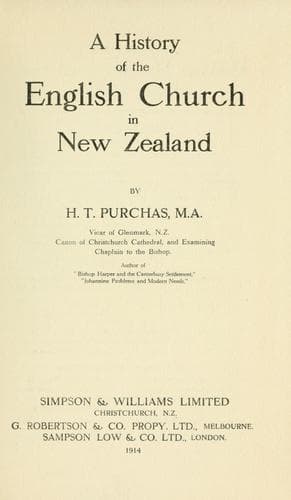
A History of the English Church in New ZealandPurchas, Henry Thomas
History
A History of the English Church in New Zealand
Purchas, Henry Thomas
Church of the Province of New Zealand -- History; New Zealand -- Church history
How the voyage ended is well known. The heavy mallet of one islander at
Nukapu gave the brave and saintly bishop instantaneous release from his
sufferings; the poisoned arrows of others caused the death, after
lingering agony, of two of his companions, the missionary Joseph Atkin
and a Melanesian teacher. The bishop's body, as it was found floating
down the lagoon, bore five wounds, inflicted doubtless in vengeance for
the violent capture of five islanders by the very traffic against which
the bishop had sent his protest to the synod.
For nearly six years the Melanesian Mission remained without a bishop,
under the faithful leadership of Dr. Codrington. But Patteson's loss
could not be replaced, nor could that of Atkin, who had managed the
navigation department. Many years elapsed before the lost
ground--especially in the Solomons--could be recovered.
Much good work was done in many of the parishes of New Zealand during
the decade of the 'seventies, and Patteson's martyrdom was not
fruitless. But, outwardly, the Church continued weak. Wellington had
lost Bishop Abraham in 1870, and, in his place, elected Archdeacon
Hadfield in recognition of his magnificent services. But the new
bishop's health was still precarious, and he failed to acquire amongst
the settlers the influence which he had formerly wielded amongst the
Maoris. Dunedin was still torn by the party spirit of the Jenner
controversy; in Waiapu, Bishop Williams was drawing toward the end of
his long and arduous life.
The weakness of the Church was revealed in a sad and startling manner
when the Provinces were abolished in 1876. The civil government became
centralised, at a time when the ecclesiastical organisation had lost its
central unity, and its power of bringing pressure to bear on national
legislation. When, in 1877, an Education bill was introduced into
parliament, the Church not only found herself outvoted, but was not even
represented in any effective way. The only parts of the colony which
could take up a strong and consistent position were Nelson and Westland.
In these districts the English Church, under Bishop Suter and Archdeacon
Harper, had co-operated with the Roman Catholics and other bodies under
their respective leaders, and had carried on an effective and successful
system of denominational schools. But nothing like this could be shown
elsewhere. Canterbury had renounced church schools in 1873, and had
reduced the religious instruction in its provincial schools to a minimum
of "history sacred and profane"; Otago and Wellington had retained
Bible-reading, but were greatly divided as to the necessity of its
continuance; Auckland had compromised with the Roman difficulty by
adopting secularism pure and simple.
Public-domain text, read in full here on John Shaqi.
Reviews
Reviews
No reviews yet
Be the first to share your thoughts on this work.
Elsewhere in the archive
Join the Discussion
Join the discussion
Sign in to leave a comment or review.
Sign InorCreate an account