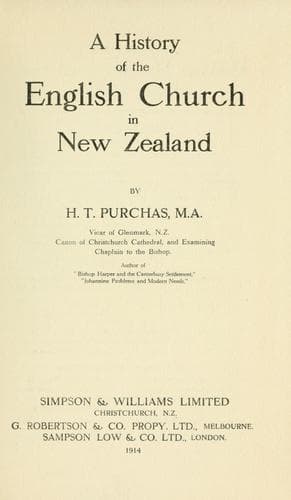
A History of the English Church in New ZealandPurchas, Henry Thomas
History
A History of the English Church in New Zealand
Purchas, Henry Thomas
Church of the Province of New Zealand -- History; New Zealand -- Church history
Three solutions of the "religious difficulty" were thus before the House
of Representatives. No reference was made by any of the speakers to the
blessings which the Christian religion had conferred upon the country.
The torn and bleeding state of Maori Christianity prevented one side
from pointing to it as an example; the other side--if mindful at all of
its existence--was too generous to point at it as a warning. Fear of
Rome seemed to be the dominating motive with most of the members, but a
small secularist minority made itself conspicuous. The Nelson, or
denominationalist, system had broken down in the larger settlements
through want of good leadership and generous co-operation; the
government scheme of elementary Bible-reading, though more widely
favoured, was so feebly advocated that its opponents could with some
justice pronounce it a "farce"; and finally the secular party won the
day by a considerable majority. Nothing was left to the Churches of the
land but the opportunity for their ministers to enter the schools,
before or after school hours, and to give instruction to such children
as might choose to attend.
But the period through which we have been passing was not all gloom. In
the diocese of Auckland, Bishop Cowie was able to re-open St. John's
College, and to place it under the charge of Dr. Kinder. Immigrants were
pouring into his diocese to settle upon the confiscated lands, and the
bishop set himself to follow them up into the remotest settlements. In
small schooners and rough cattle-boats he journeyed round the coast; on
bullock-waggons and on horseback he traversed the almost impassable
roads. Thus he made himself the friend of the settlers, and gradually
provided them with the ministrations of religion.
In the South Island, Bishop Suter, who was appointed to succeed Bishop
Hobhouse in 1866, worked vigorously and successfully in the rough mining
settlements of the west coast, as well as among the sheltered valleys
around Nelson, and the sheep stations on the eastern coast. In
Canterbury, Bishop Harper laboured on with much success, and saw a
number of churches built during this decade.
Early in the year 1877 the long interregnum in Melanesia came to its
close. Bishop Patteson's death had stirred (among others) John
Richardson Selwyn, the great bishop's New Zealand-born son, to offer
himself for missionary work. He was too young at the time for the
episcopal office, and even when he reached the canonical age his friends
were doubtful if his health would bear the strain; but he threw himself
with ardour into the work of the mission, and soon came to be regarded
as its future head. He was consecrated at Nelson on Feb. 18th, 1877, and
soon proved his fitness for the difficult work he had undertaken.
Public-domain text, read in full here on John Shaqi.
Reviews
Reviews
No reviews yet
Be the first to share your thoughts on this work.
Elsewhere in the archive
Join the Discussion
Join the discussion
Sign in to leave a comment or review.
Sign InorCreate an account