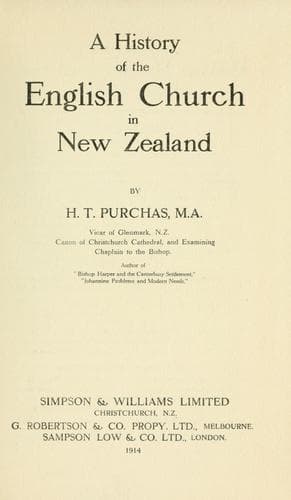
A History of the English Church in New ZealandPurchas, Henry Thomas
History
A History of the English Church in New Zealand
Purchas, Henry Thomas
Church of the Province of New Zealand -- History; New Zealand -- Church history
The Bishop of Nelson was the senior by consecration, though not by age,
and he received a large majority of lay votes. But the clergy did not
think him "safe," and gave their votes preponderantly to the veteran
Hadfield. Before the final ballot, the Bishop of Melanesia broke the
silence enjoined on such occasions, and urged the laity "not to let the
election go by default." His advocacy was successful, and at the third
ballot the Bishop of Wellington, having received a majority of all
orders, was declared by the old primate to be duly elected to fill his
place.
But this decision did not remain long uncontested. From a strictly legal
point of view, the proceedings were invalidated by the fact that the
canons gave no authority for an election until the primatial seat was
actually vacant. This technical objection was rendered more cogent by
Bishop John Selwyn's impulsive act. His speech was undoubtedly a breach
of the law, and undoubtedly also it turned the election.
The situation was a difficult one, and it affected more especially the
diocese of Christchurch. For Bishop Harper's retirement was leaving that
diocese vacant, and its synod had elected Archdeacon Julius of Ballarat
to fill Dr. Harper's place. But the election could not be completed
without the sanction of the General Synod or of the Standing Committees
of the various dioceses, and until the primacy question should be
settled it was impossible to obtain such confirmation. Bishop Suter,
acting on the verdict of the Standing Commission--which was to the
effect that the election of Bishop Hadfield was null and void--proceeded
to act as primate, and to invite the Standing Committees to confirm the
action of the Christchurch Synod. Those of Nelson, Auckland, and Waiapu
at once did so; but those of Wellington and Dunedin, holding that Bishop
Hadfield was legally elected, took no notice of the communications of
the senior bishop.
The position was undoubtedly full of interest to lawyers, but it was
painful and humiliating to devout members of the Church. Some weeks were
occupied in fruitless negotiations, but at length, through the influence
of the aged Bishop Harper, a way was discovered out of the thicket.
Bishop Hadfield resigned his claims to the primacy, and Bishop Suter,
whose position was now uncontested, summoned a special meeting of the
General Synod. It met in Wellington on April 23rd, 1890. The Bishop of
Wellington was elected primate, and the election of Archdeacon Julius to
the see of Christchurch was validated, sanctioned, and confirmed.
Public-domain text, read in full here on John Shaqi.
Reviews
Reviews
No reviews yet
Be the first to share your thoughts on this work.
Elsewhere in the archive
Join the Discussion
Join the discussion
Sign in to leave a comment or review.
Sign InorCreate an account