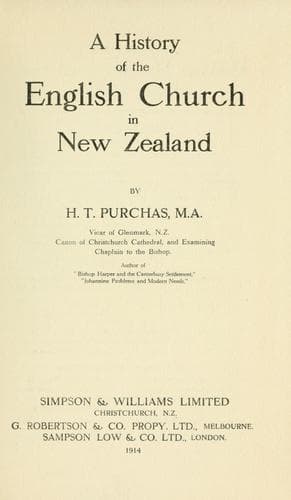
A History of the English Church in New ZealandPurchas, Henry Thomas
History
A History of the English Church in New Zealand
Purchas, Henry Thomas
Church of the Province of New Zealand -- History; New Zealand -- Church history
A sign of recovery from the exhaustion of the war-period may be found in
the stately churches which now began to rise here and there.
Christchurch Cathedral, after its years of forlorn desolation, rose
slowly from its foundations during the later 'seventies, until in 1881
the nave and tower were completed and consecrated. St. Mary's, Timaru,
was begun in 1880, and its nave completed six years later. St. John's
Cathedral, Napier, was rapidly built and consecrated as a finished
building in 1888. Nothing so artistic or so solid as these edifices had
yet been seen in the country, and nothing equal to them was produced for
many years.
Not only were new churches built: they were filled. A great impetus to
devotion was received in 1885 and 1886 from Canons Bodington and G. E.
Mason, who were sent out from Selwyn's old diocese of Lichfield to hold
missions in Auckland and Christchurch. These able men spent 10 months in
the country, and gave of their best to every place they visited.
In 1889, Bishop Harper gave notice of his intention to resign his
primacy, and, in the following year, laid down his pastoral staff. He
had reached the age of 86 before his resignation took effect, but his
mind was still vigorous, and when relieved of the cares of office he
took up the humbler work of giving divinity lessons in a girls' school.
He was pre-eminently a man of peace, but beneath the placid exterior
there lay an indomitable will. One who knew him well wrote of him thus:
"He left upon me the deep impression that he never had an ideal of power
or wealth or fame, but that to go about doing good, and to promote the
welfare of his fellow-men with all his strength, were the objects he had
in view in his whole life."
This resignation was destined to bring about a constitutional difficulty
which recalled the trying days of the Jenner incident. The question
which divided the Church was nothing less than this, Who is the
legitimate primate or chief pastor of New Zealand?
Dunedin, curiously enough, was again the point from which the trouble
emanated, and a Selwyn was again the person who unintentionally brought
it about. Bishop Harper announced his intention to resign the primacy to
a general synod at Dunedin in February, 1889. At the close of the
session he called for an election of a bishop to take his place as
primate in six months' time. The first and the second ballots were
inconclusive. Had the third ballot yielded a similar result, the primacy
would have gone, according to the canons, to the senior bishop.
Public-domain text, read in full here on John Shaqi.
Reviews
Reviews
No reviews yet
Be the first to share your thoughts on this work.
Elsewhere in the archive
Join the Discussion
Join the discussion
Sign in to leave a comment or review.
Sign InorCreate an account