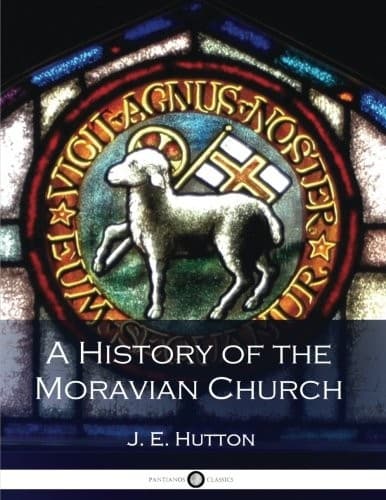
A History of the Moravian ChurchHutton, J. E. (Joseph Edmund)
Religion
A History of the Moravian Church
Hutton, J. E. (Joseph Edmund)
Moravian Church -- History
At heart, Comenius had a high opinion of his
Brethren. For nearly fifty weary years--as we shall see in the next
chapter--this genius and scholar longed and strove for the revival
of the Brethren's Church, and in many of his books he described the
Brethren, not as men who had disgraced their profession, but as heroes
holding the faith in purity. He described his Brethren as broad-minded
men, who took no part in religious quarrels, but looked towards heaven,
and bore themselves affably to all; he said to the exiles in one of his
letters, "You have endured to the end"; he described them again, in
a touching appeal addressed to the Church of England, as a model of
Christian simplicity; and he attributed their downfall in Bohemia,
not to any moral weakness, but to their neglect of education. If the
Brethren, he argued, had paid more attention to learning, they would
have gained the support of powerful friends, who would not have allowed
them to perish. I admit, of course, that Comenius was naturally partial,
and that when he speaks in praise of the Brethren we must receive his
evidence with caution; but, on the other hand, I hold that the theory of
a serious moral decline, so popular with certain German historians,
is not supported by evidence. If the Brethren had shown much sign
of corruption we should expect to find full proof of the fact in the
Catholic writers of the day. But such proof is not to hand. Not even
the Jesuit historian, Balbin, had anything serious to say against the
Brethren. The only Catholic writer, as far as I know, who attacked their
character was the famous Papal Nuncio, Carlo Caraffa. He says that the
Brethren in Moravia had become a little ambitious and avaricious, "with
some degree of luxury in their habits of life";[53] but he has no remarks
of a similar nature to make about the Brethren in Bohemia. The real
cause of the fall of the Brethren was utterly different. They fell,
not because they were morally weak, but because they were killed by the
sword or forcibly robbed of their property. They fell because Bohemia
fell; and Bohemia fell for a variety of reasons; partly because her
peasants were serfs and had no fight left in them; partly because
her nobles blundered in their choice of a Protestant King; and partly
because, when all is said, she was only a little country in the grip
of a mightier power. In some countries the Catholic reaction was due
to genuine religious fervour; in Bohemia it was brought about by brute
force; and even with all his money and his men King Ferdinand found
the destruction of the Brethren no easy task. He had the whole house of
Hapsburg on his side; he had thousands of mercenary soldiers from Spain;
he was restrained by no scruples of conscience; and yet it took him six
full years to drive the Brethren from the country. And even then he had
not completed his work. In spite of his efforts, many thousands of
the people still remained Brethren at heart; and as late as 1781,
when Joseph II.
Public-domain text, read in full here on John Shaqi.
Reviews
Reviews
No reviews yet
Be the first to share your thoughts on this work.
Elsewhere in the archive
Join the Discussion
Join the discussion
Sign in to leave a comment or review.
Sign InorCreate an account