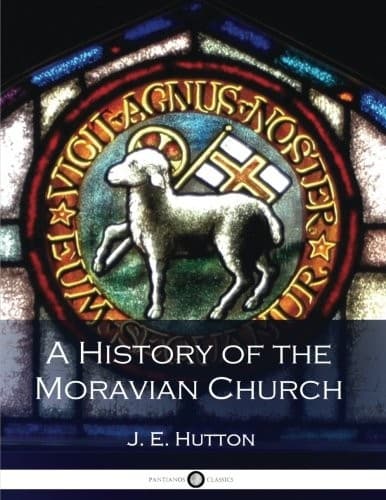
A History of the Moravian ChurchHutton, J. E. (Joseph Edmund)
Religion
A History of the Moravian Church
Hutton, J. E. (Joseph Edmund)
Moravian Church -- History
issued his Edict of Toleration, 100,000 in Bohemia and
Moravia declared themselves Brethren. We have here a genuine proof of
the Brethren's vigour. It had been handed on from father to son through
five generations. For the Brethren there was still no legal recognition
in Bohemia and Moravia; the Edict applied to Lutherans and Calvinists
only; and if the Brethren had been weak men they might now have called
themselves Lutherans or Calvinists. But this, of course, carries us
beyond the limits of this chapter. For the present King Ferdinand had
triumphed; and word was sent to the Pope at Rome that the Church of the
Brethren was no more.
CHAPTER XVI. -- COMENIUS AND THE HIDDEN SEED, 1627-1672.
But the cause of the Brethren's Church was not yet lost. As the Brethren
fled before the blast, it befell, in the wonderful providence of God,
that all their best and noblest qualities--their broadness of view,
their care for the young, their patience in suffering, their undaunted
faith--shone forth in undying splendour in the life and character of one
great man; and that man was the famous John Amos Comenius, the pioneer
of modern education and the last Bishop of the Bohemian Brethren. He was
born on March 18th, 1592, at Trivnitz, a little market town in Moravia.
He was only six years old when he lost his parents through the plague.
He was taken in hand by his sister, and was educated at the Brethren's
School at Ungarisch-Brod. As he soon resolved to become a minister,
he was sent by the Brethren to study theology, first at the Calvinist
University of Herborn in Nassau, and then at the Calvinist University
of Heidelberg. For two years (1614-1616) he then acted as master in
the Brethren's Higher School at Prerau, and then became minister of
the congregation at Fulneck. There, too, the Brethren had a school; and
there, both as minister and teacher, Comenius, with his young wife and
family, was as happy as the livelong day. But his happiness was speedily
turned to misery. The Thirty Years' War broke out. What part he took
in the Bohemian Revolution we have no means of knowing. He certainly
favoured the election of Frederick, and helped his cause in some way. "I
contributed a nail or two," he says,[54] "to strengthen the new throne."
What sort of nail he means we do not know. The new throne did not stand
very long. The troops of Ferdinand appeared at Fulneck. The village was
sacked. Comenius reeled with horror. He saw the weapons for stabbing,
for chopping, for cutting, for pricking, for hacking, for tearing and
for burning. He saw the savage hacking of limbs, the spurting of blood,
the flash of fire.
"Almighty God," he wrote in one of his books, "what is happening? Must
the whole world perish?"
Public-domain text, read in full here on John Shaqi.
Reviews
Reviews
No reviews yet
Be the first to share your thoughts on this work.
Elsewhere in the archive
Join the Discussion
Join the discussion
Sign in to leave a comment or review.
Sign InorCreate an account