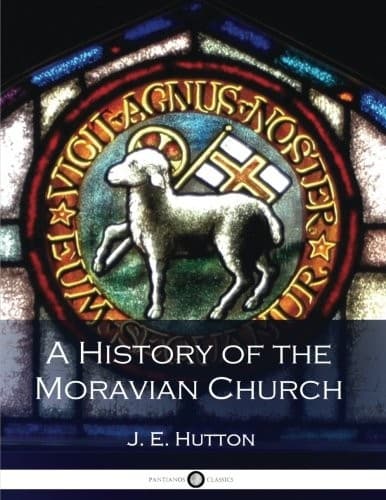
A History of the Moravian ChurchHutton, J. E. (Joseph Edmund)
Religion
A History of the Moravian Church
Hutton, J. E. (Joseph Edmund)
Moravian Church -- History
With clasped hands, and in ringing tones, Hus begged in vain for a
hearing. Again he was told to hold his peace, and silently he raised
his eyes to heaven in prayer. He was accused of denying the Catholic
doctrine of transubstantiation. He sprang to his feet in anger.
Zabarella tried to shout him down. The voice of Hus rang out above the
babel.
"I have never held, taught or preached," he cried, "that in the
sacrament of the altar material bread remains after consecration."
The trial was short and sharp. The verdict had been given beforehand.
He was now accused of another horrible crime. He had actually described
himself as the fourth person in the Godhead! The charge was monstrous.
"Let that doctor be named," said Hus, "who has given this evidence
against me."
But the name of his false accuser was never given. He was now accused
of a still more dangerous error. He had appealed to God instead of
appealing to the Church.
"O Lord God," he exclaimed, "this Council now condemns Thy action and
law as an error! I affirm that there is no safer appeal than that to the
Lord Jesus Christ."
With those brave words he signed his own death warrant. For all his
orthodoxy on certain points, he made it clearer now than ever that
he set the authority of his own conscience above the authority of the
Council; and, therefore, according to the standard of the day, he had to
be treated as a heretic.
"Moreover," he said, with his eye on the King, "I came here freely to
this Council, with a safe-conduct from my Lord the King here present,
with the desire to prove my innocence and to explain my beliefs."
At those words, said the story in later years, King Sigismund blushed.
If he did, the blush is the most famous in the annals of history; if he
did not, some think he ought to have done. For Hus the last ordeal had
now arrived; and the Bishop of Concordia, in solemn tones, read out the
dreadful articles of condemnation. For heretics the Church had then but
little mercy. His books were all to be burned; his priestly office must
be taken from him; and he himself, expelled from the Church, must be
handed over to the civil power. In vain, with a last appeal for justice,
he protested that he had never been obstinate in error. In vain he
contended that his proud accusers had not even taken the trouble to read
some of his books. As the sentence against himself was read, and the
vision of death rose up before him, he fell once more on his knees and
prayed, not for himself, but for his enemies.
"Lord Jesus Christ," he said, "pardon all my enemies, I pray thee, for
the sake of Thy great mercy! Thou knowest that they have falsely accused
me, brought forward false witnesses and false articles against me. O!
pardon them for Thine infinite mercies' sake."
Public-domain text, read in full here on John Shaqi.
Reviews
Reviews
No reviews yet
Be the first to share your thoughts on this work.
Join the Discussion
Join the discussion
Sign in to leave a comment or review.
Sign InorCreate an account