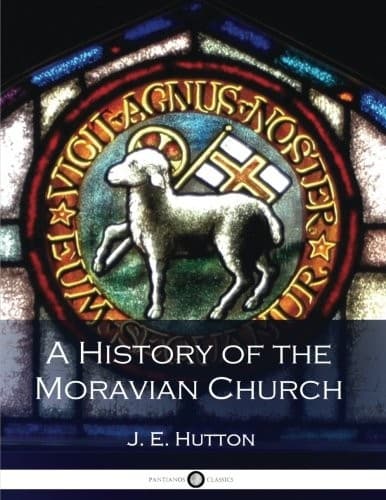
A History of the Moravian ChurchHutton, J. E. (Joseph Edmund)
Religion
A History of the Moravian Church
Hutton, J. E. (Joseph Edmund)
Moravian Church -- History
The good Bishop's words are instructive. At that time the Gospel which
Cennick preached was still a strange thing in Ulster; and Cennick
was welcomed as a true revival preacher. At Ballee and Ballynahone he
addressed a crowd of ten thousand. At Moneymore the Presbyterians begged
him to be their minister. At Ballynahone the Catholics promised that if
he would only pitch his tent there they would never go to Mass again. At
Lisnamara, the rector invited him to preach in the parish church. At New
Mills the people rushed out from their cabins, barred his way, offered
him milk, and besought him, saying, "If you cannot stop to preach, at
least come into our houses to pray." At Glenavy the road was lined with
a cheering multitude for full two miles. At Castle Dawson, Mr. Justice
Downey, the local clergyman, and some other gentry, kissed him in public
in the barrack yard. As he galloped along the country roads, the farm
labourers in the fields would call out after him, "There goes Swaddling
Jack"; he was known all over Ulster as "the preacher"; his fame ran on
before him like a herald; Count Zinzendorf called him "Paul Revived";
and his memory lingers down to the present day.
For Cennick, of course, was more than a popular orator. As he was now a
minister of the Brethren's Church, he considered it his duty, wherever
possible, to build chapels, to organize congregations, and to introduce
Moravian books and customs; and in this work he had the assistance of
La Trobe, Symms, Caries, Cooke, Wade, Knight, Brampton, Pugh, Brown,
Thorne, Hill, Watson, and a host of other Brethren whose names need not
be mentioned. I have not mentioned the foregoing list for nothing. It
shows that most of Cennick's assistants were not Germans, but Englishmen
or Irishmen; and the people could not raise the objection that the
Brethren were suspicious foreigners. At this time, in fact, the strength
of the Brethren was enormous. At the close of his work, John Cennick
himself had built ten chapels, and established two hundred and twenty
religious societies. Around Lough Neagh the Brethren lay like locusts;
and the work here was divided into four districts. At the north-east
corner they had four societies, with chapels at Ballymena, Gloonen,
and Grogan, and a growing cause at Doagh; at the north-west corner, a
society at Lisnamara, established later as a congregation at Gracefield;
at the south-west corner, in Co. Armagh, three chapels were being built;
and at the south-east corner, they had several societies, and had built,
or were building, chapels at Ballinderry, Glenavy, and Kilwarlin.
Public-domain text, read in full here on John Shaqi.
Reviews
Reviews
No reviews yet
Be the first to share your thoughts on this work.
Elsewhere in the archive
Join the Discussion
Join the discussion
Sign in to leave a comment or review.
Sign InorCreate an account