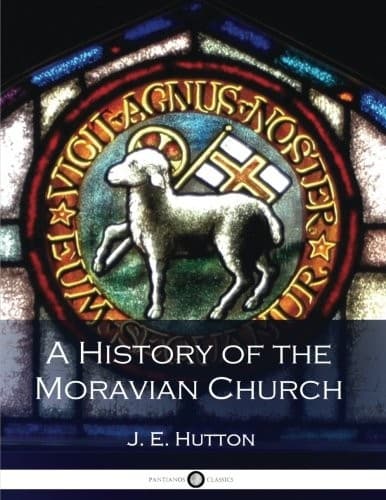
A History of the Moravian ChurchHutton, J. E. (Joseph Edmund)
Religion
A History of the Moravian Church
Hutton, J. E. (Joseph Edmund)
Moravian Church -- History
At this distance of time the Brethren's work in Ulster has about it a
certain glamour of romance. But in reality the conditions were far from
attractive. It is hard for us to realize now how poor those Irish people
were. They lived in hovels made of loose sods, with no chimneys; they
shared their wretched rooms with hens and pigs; and toiling all day in
a damp atmosphere, they earned their bread by weaving and spinning. The
Brethren themselves were little better off. At Gloonen, a small village
near Gracehill, the Brethren of the first Lough Neagh district made
their headquarters in a cottage consisting of two rooms and two
small "closets"; and this modest abode of one story was known in the
neighbourhood as "The Great House at Gloonen." Again, at a Conference
held in Gracehill, the Brethren, being pinched for money, solemnly
passed a resolution never to drink tea more than once a day.
And yet there is little to show to-day for these heroic labours. If
the visitor goes to Ulster now and endeavours to trace the footsteps
of Cennick, he will find it almost impossible to realize how great
the power of the Brethren was in those palmy days. At Gracehill, near
Ballymena, he will find the remains of a settlement. At Ballymena
itself, now a growing town, he will find to his surprise that the
Brethren's cause has ceased to exist. At Gracefield, Ballinderry, and
Kilwarlin--where once Cennick preached to thousands--he will find but
feeble, struggling congregations. At Gloonen the people will show him
"Cennick's Well"; at Kilwarlin he may stand under "Cennick's Tree"; and
at Portmore, near Lough Beg, he will see the ruins of the old church,
where Jeremy Taylor wrote his "Holy Living and Holy Dying," and where
Cennick slept many a night. At Drumargan (Armagh), he will find a barn
that was once a Moravian Chapel, and a small farmhouse that was once
a Sisters' House; and at Arva (Co. Cavan), he may stand on a hillock,
still called "Mount Waugh," in memory of Joseph Waugh, a Moravian
minister. For the rest, however, the work has collapsed; and Cennick's
two hundred and twenty societies have left not a rack behind.
Public-domain text, read in full here on John Shaqi.
Reviews
Reviews
No reviews yet
Be the first to share your thoughts on this work.
Elsewhere in the archive
Join the Discussion
Join the discussion
Sign in to leave a comment or review.
Sign InorCreate an account