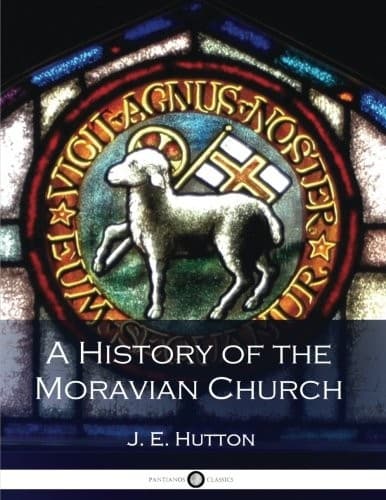
A History of the Moravian ChurchHutton, J. E. (Joseph Edmund)
Religion
A History of the Moravian Church
Hutton, J. E. (Joseph Edmund)
Moravian Church -- History
fond, like most of the Brethren, of overdrawn sentimental language. If
a man could read Zinzendorf's "Litany of the Wounds of Jesus," and then
shed tears of joy, as Cennick tells us he did himself, there must have
been an unhealthy taint in his blood. He was present at Herrnhaag at
the Sifting-Time, and does not appear to have been shocked. In time
his sentimentalism made him morbid. As he had a wife and two children
dependent on him, he had no right to long for an early death; and yet he
wrote the words in his pocket-book:--
Now, Lord, at peace with Thee and all below,
Let me depart, and to Thy Kingdom go.
For this blemish, however, he was more to be pitied than blamed. It was
partly the result of ill-health and overwork; and, on the whole, it was
merely a trifle when set beside that winsome grace, that unselfish zeal,
that modest devotion, and that sunny piety, which charmed alike the
Wiltshire peasants, the Papist boys of Dublin, and the humble weavers
and spinners of the North of Ireland.[122]
CHAPTER XII. -- THE APPEAL TO PARLIAMENT, 1742-1749.
Meanwhile, however, the Brethren in England had been bitterly opposed.
For this there were several reasons. First, the leading Brethren in
England were Germans; and that fact alone was quite enough to prejudice
the multitude against them {1742-3.}. For Germans our fathers had then
but little liking; they had a German King on the throne, and they did
not love him; and the general feeling in the country was that if a man
was a foreigner he was almost sure to be a conspirator or a traitor. Who
were these mysterious foreigners? asked the patriotic Briton. Who were
these "Moravians," these "Herrnhuters," these "Germans," these "Quiet in
the Land," these "Antinomians"? The very names of the Brethren aroused
the popular suspicion. If a man could prove that his name was John
Smith, the presumption was that John Smith was a loyal citizen; but if
he was known as Gussenbauer or Ockershausen, he was probably another Guy
Fawkes, and was forming a plot to blow up the House of Commons. At
the outset therefore the Brethren were accused of treachery. At Pudsey
Gussenbauer was arrested, tried at Wakefield, and imprisoned in York
Castle. At Broadoaks, in Essex, the Brethren had opened a school, and
were soon accused of being agents of the Young Pretender. They had, it
was said, stored up barrels of gunpowder; they had undermined the whole
neighbourhood, and intended to set the town of Thaxted on fire. At three
o'clock one afternoon a mob surrounded the building, and tried in vain
to force their way in. Among them were a sergeant and a corporal. The
warden, Metcalfe, admitted the officers, showed them round the house,
and finally led them to a room where a Bible and Prayer-book were lying
on the table. At this sight the officers collapsed in amazement.
"Aye," said the corporal, "this is proof enough that you are no Papists;
if you were, this book would not have lain here."
Public-domain text, read in full here on John Shaqi.
Reviews
Reviews
No reviews yet
Be the first to share your thoughts on this work.
Elsewhere in the archive
Join the Discussion
Join the discussion
Sign in to leave a comment or review.
Sign InorCreate an account