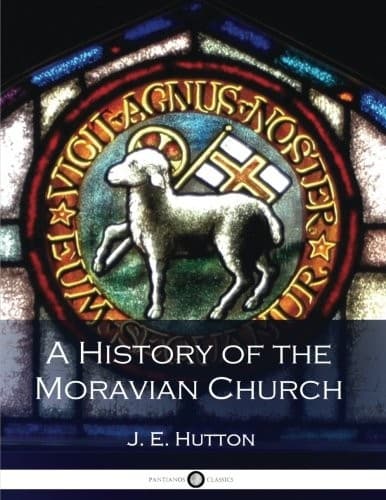
A History of the Moravian ChurchHutton, J. E. (Joseph Edmund)
Religion
A History of the Moravian Church
Hutton, J. E. (Joseph Edmund)
Moravian Church -- History
For this decline there were three causes. The first was financial. At
the very time when the Brethren in Ulster had obtained a firm hold upon
the affections of the people the Moravian Church was passing through
a financial crisis; and thus, when money would have been most useful,
money was not to be had. The second was the bad system of management.
Again, as in Yorkshire and Wiltshire, the Brethren pursued the system
of centralization; built a settlement at Gracehill, and made the
other congregations dependent on Gracehill, just as the Yorkshire
congregations were dependent on Fulneck. The third cause was the early
death of Cennick himself. At the height of his powers he broke down in
body and in mind; and, worn out with many labours, he became the victim
of mental depression. For some time the conviction had been stealing
upon him that his work in this world was over; and in a letter to John
de Watteville, who had twice inspected the Irish work, he said, "I think
I have finished with the North of Ireland. If I stay here much longer
I fear I shall damage His work." At length, as he rode from Holyhead
to London, he was taken seriously ill; and arrived at Fetter Lane in
a state of high fever and exhaustion. For a week he lay delirious and
rambling, in the room which is now used as the Vestry of the Moravian
Chapel; and there, at the early age of thirty-six, he died {July 4th,
1755.}. If the true success is to labour, Cennick was successful; but if
success is measured by visible results, he ended his brief and brilliant
career in tragedy, failure and gloom. Of all the great preachers of the
eighteenth century, not one was superior to him in beauty of character.
By the poor in Ireland he was almost worshipped. He was often attacked
and unjustly accused; but he never attacked in return. We search his
diary and letters in vain for one single trace of bitter feeling. He was
inferior to John Wesley in organizing skill, and inferior to Whitefield
in dramatic power; but in devotion, in simplicity, and in command over
his audience he was equal to either. At the present time he is chiefly
known in this country as the author of the well-known grace before
meat, "Be present at our table, Lord"; and some of his hymns, such as
"Children of the Heavenly King," and "Ere I sleep, for every favour,"
are now regarded as classics. His position in the Moravian Church was
peculiar. Of all the English Brethren he did the most to extend the
cause of the Moravian Church in the United Kingdom, and no fewer than
fifteen congregations owed their existence, directly or indirectly, to
his efforts; and yet, despite his shining gifts, he was never promoted
to any position of special responsibility or honour. He was never placed
in sole charge of a congregation; and he was not made superintendent of
the work in Ireland. As a soldier in the ranks he began; as a soldier in
the ranks he died. He had one blemish in his character. He was far too
Public-domain text, read in full here on John Shaqi.
Reviews
Reviews
No reviews yet
Be the first to share your thoughts on this work.
Elsewhere in the archive
Join the Discussion
Join the discussion
Sign in to leave a comment or review.
Sign InorCreate an account