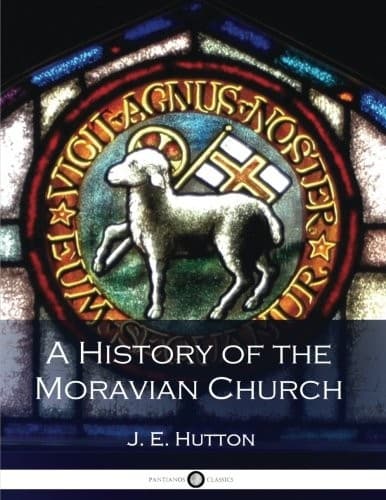
A History of the Moravian ChurchHutton, J. E. (Joseph Edmund)
Religion
A History of the Moravian Church
Hutton, J. E. (Joseph Edmund)
Moravian Church -- History
The first reading was on March 28th, and the passage through the House
of Commons was smooth. At the second reading, on April 1st, General
Oglethorpe was asked to explain why the privilege of affirming should be
extended to Moravians in Great Britain and Ireland. Why not confine it
to the American colonies? His answer was convincing. If the privilege,
he said, were confined to America, it would be no privilege at all. At
that time all cases tried in America could be referred to an English
Court of Appeal. If the privilege, therefore, were confined to America,
the Brethren would be constantly hampered by vexatious appeals to
England; and an English Court might at any moment upset the decision of
an American Court. The explanation was accepted; the third reading came
on; and the Bill passed the House of Commons unaltered.
In the House of Lords there was a little more opposition. As the
Brethren were described as an "Episcopal Church," it was feared that the
Bishops might raise an objection; but the Bishops met at Lambeth Palace,
and resolved not to oppose. At first Dr. Sherlock, Bishop of London,
objected; but even he gave way in the end, and when the Bill came before
the Lords not a single Bishop raised his voice against it. The only
Bishop who spoke was Maddox, of Worcester, and he spoke in the name of
the rest.
"Our Moravian Brethren," he said, "are an ancient Episcopal Church. Of
all Protestants, they come the nearest to the Established Church in this
kingdom in their doctrine and constitution. And though the enemy has
persecuted them from several quarters, the soundness of their faith and
the purity of their morals have defended them from any imputation of
Popery and immorality."
The one dangerous opponent was Lord Chancellor Hardwicke. He objected
to the clause about the certificate. If a man wished to prove himself a
Moravian, let him do so by bringing witnesses. What use was a Bishop's
certificate? It would not be accepted by any judge in the country.
On the other hand, Lord Granville, in a genial speech, spoke highly of
the Brethren. As some members were still afraid that the whole country
might become Moravians, and refuse to defend our land against her foes,
he dismissed their fears by an anecdote about a Quaker. At one time,
he said, in the days of his youth, the late famous admiral, Sir Charles
Wager, had been mate on a ship commanded by a Quaker; and on one
occasion the ship was attacked by a French privateer. What, then, did
the Quaker captain do? Instead of fighting the privateer himself, he
gave over the command to Wager, captured the privateer, and made his
fortune. But the Brethren, he held, were even broader minded than the
Quakers.
"I may compare them," he said, "to a casting-net over all Christendom,
to enclose all denominations of Christians. If you like episcopacy, they
have it; if you choose the Presbytery of Luther or Calvin, they have
that also; and if you are pleased with Quakerism, they have something of
that."
Public-domain text, read in full here on John Shaqi.
Reviews
Reviews
No reviews yet
Be the first to share your thoughts on this work.
Elsewhere in the archive
Join the Discussion
Join the discussion
Sign in to leave a comment or review.
Sign InorCreate an account