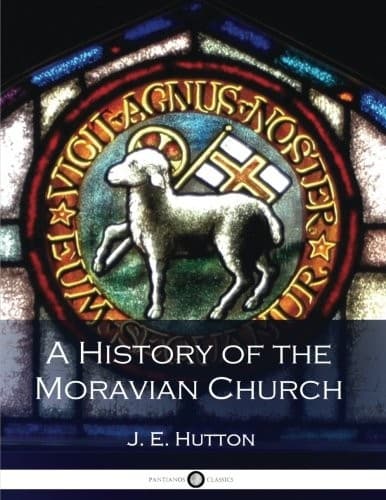
A History of the Moravian ChurchHutton, J. E. (Joseph Edmund)
Religion
A History of the Moravian Church
Hutton, J. E. (Joseph Edmund)
Moravian Church -- History
explained their own interpretation of those commandments. "Lest it
should be thought," they said, "that they seek, perhaps, some subterfuge
in the pretended indeterminate nature of Scripture-style, they know very
well that it becomes them to understand every precept and obligation in
the same manner as the generality of serious Christians understand the
same (and this is a thing, God be praised, pretty well fixed), or, if
at all differently, then always stricter." The purpose of the book was
clear. It was a handy guide to daily conduct. It was meant to be learned
by heart, and was issued in such size and form that it could be carried
about in the pocket. It was "a faithful monitor to souls who, having
been first washed through the blood of Jesus, do now live in the Spirit,
to walk also in the Spirit." To the Brethren this little Christian guide
was a treasure. As long as they ordered their daily conduct by these
"convenient rules for the house of their pilgrimage," they could smile
at the sneers of Rimius and his supporters. The Moravian influence in
England was now at high tide. At the very time when their enemies were
denouncing them as immoral Antinomians, they established their strongest
congregations at Fulneck, Gomersal, Wyke, Mirfield, Dukinfield, Bristol,
and Gracehill {1755.}; and in all their congregations the "Statutes"
were enforced with an iron hand.
Thus did the Brethren repel the attacks of their assailants. From this
chapter one certain conclusion follows. The very fact that the Brethren
were so fiercely attacked is a proof how strong they were. As the reader
wanders over England, he may see, if he knows where to look, memorials
of their bygone labours. In Northampton is an auction room that was once
a Moravian chapel. In Bullock Smithy is a row of cottages named "Chapel
Houses," where now the Brethren are forgotten. In a private house at
Bolton, Lancashire, will be found a cupboard that was once a Moravian
Pulpit. In Wiltshire stands the "two o'clock chapel," where Cennick used
to preach. We may learn much from such memorials as these. We may learn
that the Brethren played a far greater part in the Evangelical Revival
than most historians have recognised; that they worked more like the
unseen leaven than like the spreading mustard tree; that they hankered
not after earthly pomp, and despised what the world calls success; and
that, reviled, insulted, and misrepresented, they pursued their quiet
way, content with the reward which man cannot give.
CHAPTER XIV. -- THE AMERICAN EXPERIMENTS, 1734-1762.
Public-domain text, read in full here on John Shaqi.
Reviews
Reviews
No reviews yet
Be the first to share your thoughts on this work.
Elsewhere in the archive
Join the Discussion
Join the discussion
Sign in to leave a comment or review.
Sign InorCreate an account