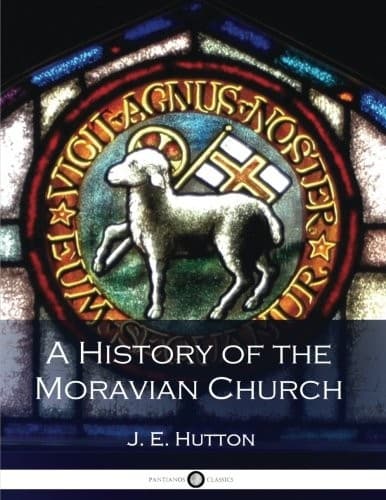
A History of the Moravian ChurchHutton, J. E. (Joseph Edmund)
Religion
A History of the Moravian Church
Hutton, J. E. (Joseph Edmund)
Moravian Church -- History
he said, "worked with his own hands, so as to be able to preach the
Gospel without pay, so we, according to our ability, will do the same;
and thus even a child of four will be able, by plucking wool, to serve
the Gospel."
For patient devotion and heroic self-sacrifice these humble toilers at
the Bethlehem-Nazareth "Economy" are unsurpassed in the history of the
Brethren's Church. They built their own houses; they made their own
clothes and boots; they tilled the soil and provided their own meat,
vegetables, bread, milk, and eggs; they sawed their own wood, spun their
own yarn, and wove their own cloth; and then, selling at the regular
market price what was not required for their personal use, they spent
the profits in the support of preachers, teachers, and missionaries in
various parts of North America. For a motto they took the words: "In
commune oramus, in commune laboramus, in commune patimur, in commune
gaudeamus"; i.e., together we pray, together we labour, together we
suffer, together we rejoice. The motive, however, was not social, but
religious. "It is nothing," said Spangenberg himself, "but love to the
Lamb and His Church." For this cause the ploughman tilled the soil, the
women sewed, the joiner sawed, the blacksmith plied his hammer; for
this cause the fond mothers, with tears in their eyes, handed over their
children to the care of guardians, so that they themselves might be free
to toil for the Master. Thus every trade was sanctified; and thus did
all, both old and young, spend all their powers for the Gospel's sake.
If there is any distinction between secular and sacred, that distinction
was unknown at Bethlehem and Nazareth. At Bethlehem the Brethren
accounted it an honour to chop wood for the Master's sake; and the
fireman, said Spangenberg, felt his post as important "as if he were
guarding the Ark of the Covenant." For the members of each trade or
calling a special series of services was arranged; and thus every toiler
was constantly reminded that he was working not for himself but for God.
The number of lovefeasts was enormous. At the opening of the harvest
season the farm labourers held an early morning lovefeast; the discourse
was partly on spiritual topics and partly on rules of diet; then the
sickles were handed out; and the whole band, with hymns of praise on
their lips, set off for the harvest field. For days at a time the Single
Brethren would be in the forest felling trees; but before they set off
they had a lovefeast, and when they returned they had another. As soon
as the joiners had the oil-mill ready they celebrated the event in a
lovefeast. The spinners had a lovefeast once a week. The joiners, the
weavers, the cartwrights, the smiths, the hewers of wood, the milkers
of cows, the knitters, the sewers, the cooks, the washerwomen--all had
their special lovefeasts. At one time the joyful discovery was made
that a Brother had served a year in the kitchen, and was ready to serve
Public-domain text, read in full here on John Shaqi.
Reviews
Reviews
No reviews yet
Be the first to share your thoughts on this work.
Elsewhere in the archive
Join the Discussion
Join the discussion
Sign in to leave a comment or review.
Sign InorCreate an account