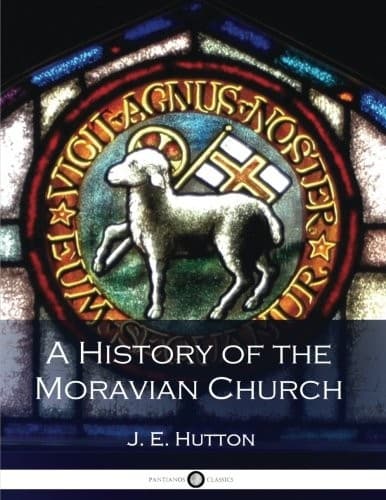
A History of the Moravian ChurchHutton, J. E. (Joseph Edmund)
Religion
A History of the Moravian Church
Hutton, J. E. (Joseph Edmund)
Moravian Church -- History
another; and thereupon the whole settlement held a general lovefeast
in his honour. For the mothers a special meeting was held, at which an
expert gave instructions on the art of bringing up children; and at this
meeting, while the lecturer discoursed or occasional hymns were sung,
the women were busy with their hands. One made shoes, another tailored,
another ground powder for the chemist's shop, another copied invoices
and letters, another sliced turnips, another knitted socks. For each
calling special hymns were composed and sung. If these hymns had been
published in a volume we should have had a Working-man's Hymnbook. Thus
every man and woman at Bethlehem-Nazareth had enlisted in the missionary
army. Never, surely, in the history of Protestant Christianity were
the secular and the sacred more happily wedded. "In our Economy," said
Spangenberg, "the spiritual and physical are as closely united as a
man's body and soul; and each has a marked effect upon the other." If
a man lost his touch with Christ it was noticed that he was careless in
his work; but as long as his heart was right with God his eye was clear
and his hand steady and firm. At the head of the whole concern stood
Spangenberg, a business man to the finger tips. If genius is a capacity
for taking pains, then Spangenberg was a genius of the finest order. He
drew up regulations dealing with every detail of the business, and at
his office he kept a strict account of every penny expended, every yard
of linen woven, every pound of butter made, and every egg consumed.
As long as Spangenberg was on the spot the business arrangements were
perfect; he was assisted by a Board of Directors, known as the Aufseher
Collegium; and so great was the enterprise shown that before the close
of his first period of administration the Brethren had several farms and
thirty-two industries in full working order. It was this which impressed
our House of Commons, and enabled them, in the Act of 1749, to recognize
the Brethren "as a sober and industrious people." For that Act the
credit must be given, not to the airy dreams of Zinzendorf, but to
the solid labours of Spangenberg. At the time when the Bill was under
discussion the chief stress was laid, in both Houses, on the results of
Spangenberg's labours; and so deeply was Earl Granville impressed that
he offered the Brethren a hundred thousand acres in North Carolina. At
length, accompanied by five other Brethren, Spangenberg himself set
off to view the land, selected a site, organized another "Economy,"
established two congregations, named Bethabara and Bethany, and thus
became the founder of the Southern Province of the Brethren's Church in
America.
Public-domain text, read in full here on John Shaqi.
Reviews
Reviews
No reviews yet
Be the first to share your thoughts on this work.
Elsewhere in the archive
Join the Discussion
Join the discussion
Sign in to leave a comment or review.
Sign InorCreate an account