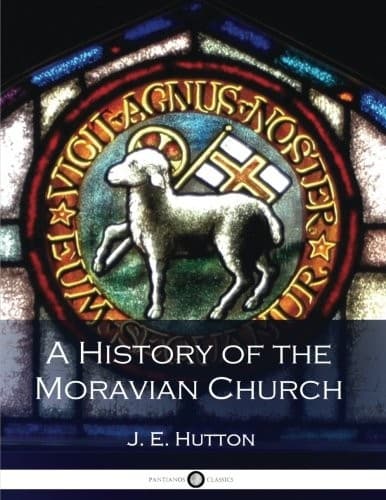
A History of the Moravian ChurchHutton, J. E. (Joseph Edmund)
Religion
A History of the Moravian Church
Hutton, J. E. (Joseph Edmund)
Moravian Church -- History
As we enter on the closing stages of our journey, the character of the
landscape changes; and, leaving behind the wild land of romance and
adventure, we come out on the broad, high road of slow but steady
progress. The death of Zinzendorf was no crushing blow. At first some
enemies of the Brethren rejoiced, and one prophet triumphantly remarked:
"We shall now see an end of these Moravians." But that time the prophet
spoke without his mantle. Already the Brethren were sufficiently strong
to realize their calling in the world. In Saxony they had established
powerful congregations at Herrnhut and Kleinwelke; in Silesia, at
Niesky, Gnadenberg, Gnadenfrei and Neusalz; in Central Germany, at
Ebersdorf, Neudietendorf and Barby; in North Germany, at Rixdorf and
Berlin; in West Germany, at Neuwied-on-the-Rhine; in Holland, at Zeist,
near Utrecht. At first sight this list does not look very impressive;
but we must, of course, bear in mind that most of these congregations
were powerful settlements, that each settlement was engaged in Diaspora
work, and that the branches of that work had extended to Denmark,
Switzerland and Norway. In Great Britain a similar principle held good.
In England the Brethren had flourishing causes at Fulneck, Gomersal,
Mirfield, Wyke, Ockbrook, Bedford, Fetter Lane, Tytherton, Dukinfield,
Leominster; in Ireland, at Dublin, Gracehill, Gracefield, Ballinderry
and Kilwarlin; and around each of these congregations were numerous
societies and preaching places. In North America they had congregations
at Bethlehem, Emmaus, Graceham, Lancaster, Lititz, Nazareth, New Dorp,
New York, Philadelphia, Schoeneck and York (York Co.); and in
addition, a number of preaching places. In Greenland they had built the
settlements of New Herrnhut and Lichtenau. In the West Indies they had
established congregations in St. Thomas, St. Croix, St. Jan, Jamaica
and Antigua. In Berbice and Surinam they had three main centres of
work. Among the Red Indians Zeisberger was busily engaged. As accurate
statistics are not available, I am not able to state exactly how
many Moravians there were then in the world; but we know that in the
mission-field alone they had over a thousand communicant members and
seven thousand adherents under their special care.
Public-domain text, read in full here on John Shaqi.
Reviews
Reviews
No reviews yet
Be the first to share your thoughts on this work.
Elsewhere in the archive
Join the Discussion
Join the discussion
Sign in to leave a comment or review.
Sign InorCreate an account