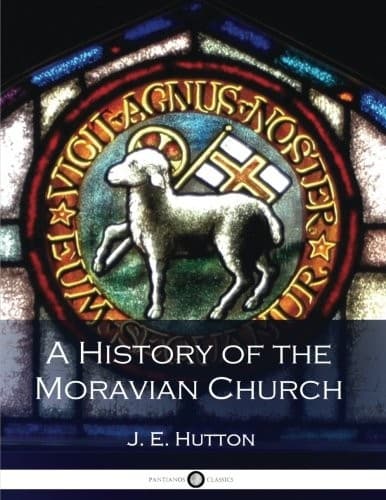
A History of the Moravian ChurchHutton, J. E. (Joseph Edmund)
Religion
A History of the Moravian Church
Hutton, J. E. (Joseph Edmund)
Moravian Church -- History
As soon, then, as the leading Brethren in Herrnhut--such as John de
Watteville, Leonard Dober, David Nitschmann, the Syndic, Frederick
Köber, and others--had recovered from the shock occasioned by
Zinzendorf's death, they set about the difficult task of organizing
the work of the whole Moravian Church. First, they formed a provisional
Board of Directors, known as the Inner Council; next, they despatched
two messengers to America, to summon the practical Spangenberg home
to take his place on the board; and then, at the earliest convenient
opportunity, they summoned their colleagues to Marienborn for the first
General Representative Synod of the Renewed Church of the Brethren.
As the Count had left the affairs of the Church in confusion, the
task before the Brethren was enormous {1764.}. They had their Church
constitution to frame; they had their finances to straighten out; they
had their mission in the world to define; they had, in a word, to bring
order out of chaos; and so difficult did they find the task that eleven
years passed away before it was accomplished to any satisfaction. For
thirty years they had been half blinded by the dazzling brilliance of
Zinzendorf; but now they began to see a little more clearly. As long
as Zinzendorf was in their midst, an orderly system of government was
impossible. It was now an absolute necessity. The reign of one man was
over; the period of constitutional government began. At all costs, said
the sensible Frederick Köber, the Count must have no successor. For the
first time the Synod was attended by duly elected congregation deputies:
those deputies came not only from Germany, but from Great Britain,
America and the mission-field; and thus the voice of the Synod was the
voice, not of one commanding genius, but of the whole Moravian Church.
The first question to settle was the Church's Mission. For what purpose
did the Moravian Church exist? To that question the Brethren gave a
threefold answer. First, they said, they must labour in the whole
world; second, their fundamental doctrine must be the doctrine of
reconciliation through the merits of the life and sufferings of Christ
as set forth in the Holy Scriptures and in the Augsburg Confession; and,
third, in their settlements they would continue to enforce that strict
discipline--including the separation of the sexes--without which the
Gospel message would be a mockery. Thus the world was their parish, the
cross their message, the system of discipline their method.
Public-domain text, read in full here on John Shaqi.
Reviews
Reviews
No reviews yet
Be the first to share your thoughts on this work.
Elsewhere in the archive
Join the Discussion
Join the discussion
Sign in to leave a comment or review.
Sign InorCreate an account