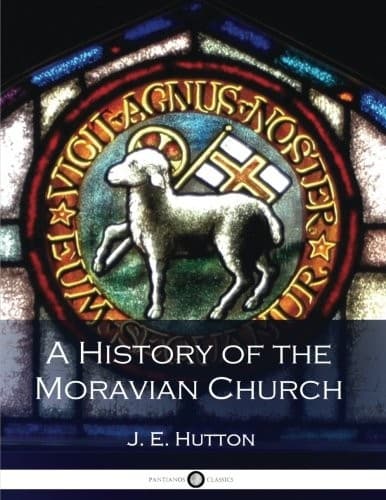
A History of the Moravian ChurchHutton, J. E. (Joseph Edmund)
Religion
A History of the Moravian Church
Hutton, J. E. (Joseph Edmund)
Moravian Church -- History
For her cradle and her earliest home we turn to the distressful land
of Bohemia, and the people called Bohemians, or Czechs. To us English
readers Bohemia has many charms. As we call to mind our days at school,
we remember, in a dim and hazy way, how famous Bohemians in days of yore
have played some part in our national story. We have sung the praises at
Christmas time of the Bohemian Monarch, "Good King Wenceslaus." We have
read how John, the blind King of Bohemia, fell mortally wounded at the
Battle of Crecy, how he died in the tent of King Edward III., and how
his generous conqueror exclaimed: "The crown of chivalry has fallen
today; never was the like of this King of Bohemia." We have all read,
too, how Richard II. married Princess Anne of Bohemia; how the Princess,
so the story goes, brought a Bohemian Bible to England; how Bohemian
scholars, a few years later, came to study at Oxford; how there they
read the writings of Wycliffe, the "Morning Star of the Reformation";
and how, finally, copies of Wycliffe's books were carried to Bohemia,
and there gave rise to a religious revival of world-wide importance.
We have struck the trail of our journey. For one person that Wycliffe
stirred in England, he stirred hundreds in Bohemia. In England his
influence was fleeting; in Bohemia it was deep and abiding. In England
his followers were speedily suppressed by law; in Bohemia they became
a great national force, and prepared the way for the foundation of the
Church of the Brethren.
For this startling fact there was a very powerful reason. In many ways
the history of Bohemia is very like the history of Ireland, and the best
way to understand the character of the people is to think of our Irish
friends as we know them to-day. They sprang from the old Slavonic stock,
and the Slavonic is very like the Keltic in nature. They had fiery
Slavonic blood in their veins, and Slavonic hearts beat high with hope
in their bosoms. They had all the delightful Slavonic zeal, the Slavonic
dash, the Slavonic imagination. They were easy to stir, they were swift
in action, they were witty in speech, they were mystic and poetic in
soul, and, like the Irish of the present day, they revelled in the joy
of party politics, and discussed religious questions with the keenest
zest. With them religion came first and foremost. All their poetry was
religious; all their legends were religious; and thus the message of
Wycliffe fell on hearts prepared to give it a kindly welcome.
Public-domain text, read in full here on John Shaqi.
Reviews
Reviews
No reviews yet
Be the first to share your thoughts on this work.
Join the Discussion
Join the discussion
Sign in to leave a comment or review.
Sign InorCreate an account