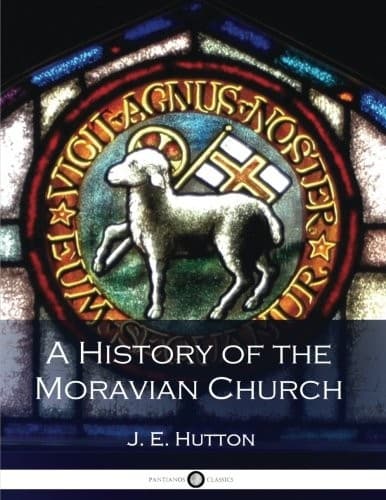
A History of the Moravian ChurchHutton, J. E. (Joseph Edmund)
Religion
A History of the Moravian Church
Hutton, J. E. (Joseph Edmund)
Moravian Church -- History
"Henceforth," he wrote gladly to King George Podiebrad, "we have done
with the Church of Rome." As he saw the evening of life draw near, he
urged his Brethren more and more to hold fast the teaching of Peter of
Chelcic, and to regulate their daily conduct by the law of Christ; and
by that law of Christ he probably meant the "Six Commandments" of
the Sermon on the Mount.[15] He took these Commandments literally,
and enforced them with a rod of iron. No Brother could be a judge or
magistrate or councillor. No Brother could take an oath or keep an inn,
or trade beyond the barest needs of life. No noble, unless he laid
down his rank, could become a Brother at all. No peasant could render
military service or act as a bailiff on a farm. No Brother could ever
divorce his wife or take an action at law. As long as Gregory remained
in their midst, the Brethren held true to him as their leader. He had
not, says Gindely, a single trace of personal ambition in his nature;
and, though he might have become a Bishop, he remained a layman to the
end. Full of years he died, and his bones repose in a cleft where tufts
of forget-me-not grow, at Brandeis-on-the-Adler, hard by the Moravian
frontier {Sept.13th, 1473.}.
CHAPTER VI. -- LUKE OF PRAGUE AND THE HIGH CHURCH REACTION. 1473-1530.
Of the Brethren who settled in the valley of Kunwald the greater number
were country peasants and tradesmen of humble rank. But already the
noble and mighty were pressing in. As the eyes of Gregory closed in
death, a new party was rising to power. Already the Brethren were strong
in numbers, and already they were longing to snap the fetters that
Gregory had placed upon their feet. From Neustadt in the North to Skutch
in the South, and from Chlumec in the West to Kunwald in the East,
they now lay thickly sprinkled; and in all the principal towns of that
district, an area of nine hundred square miles, they were winning
rich and influential members. In came the University dons; in came the
aldermen and knights. In came, above all, a large colony of Waldenses,
who had immigrated from the Margravate of Brandenburg {1480.}. Some
settled at Fulneck, in Moravia, others at Landskron, in Bohemia;
and now, by their own request, they were admitted to the Brethren's
Church.[16] For a while the Brethren held to the rule that if a nobleman
joined their Church he must first lay down his rank. But now that rule
was beginning to gall and chafe. They were winning golden opinions on
every hand; they were becoming known as the best men for positions of
trust in the State; they were just the men to make the best magistrates
and aldermen; and thus they felt forced by their very virtues to
renounce the narrow ideas of Peter and to play their part in national
and city life.
Public-domain text, read in full here on John Shaqi.
Reviews
Reviews
No reviews yet
Be the first to share your thoughts on this work.
Join the Discussion
Join the discussion
Sign in to leave a comment or review.
Sign InorCreate an account