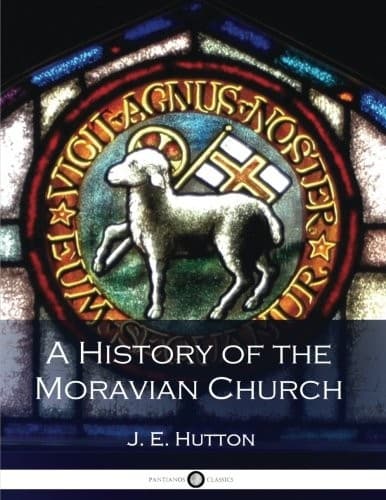
A History of the Moravian ChurchHutton, J. E. (Joseph Edmund)
Religion
A History of the Moravian Church
Hutton, J. E. (Joseph Edmund)
Moravian Church -- History
In this instance, however, the devil was innocent. The real culprit was
Bishop Luke of Prague. Of all the services rendered by Luke to the cause
of popular education and moral and spiritual instruction, the greatest
was his publication of his "Catechism for Children," commonly known
as "The Children's Questions." It was a masterly and comprehensive
treatise. It was published first, of course, in the Bohemian language
{1502.}. It was published again in a German edition for the benefit of
the German members of the Church {1522.}. It was published again, with
some alterations, by a Lutheran at Magdeburg {1524.}. It was published
again, with more alterations, by another Lutheran, at Wittenberg
{1525.}. It was published again, in abridged form, at Zürich, and was
recommended as a manual of instruction for the children at St. Gallen
{1527.}. And thus it exercised a profound influence on the whole course
of the Reformation, both in Germany and in Switzerland. For us, however,
the point of interest is its influence in Bohemia and Moravia. It was
not a book for the priests. It was a book for the fathers of families.
It was a book found in every Brother's home. It was the children's
"Reader." As the boys and girls grew up in the Brethren's Church, they
learned to read, not in national schools, but in their own homes; and
thus the Brethren did for the children what ought to have been done by
the State. Among them the duties of a father were clearly defined. He
was both a schoolmaster and a religious instructor. He was the priest in
his own family. He was to bring his children up in the Christian faith.
He was not to allow them to roam at pleasure, or play with the wicked
children of the world. He was to see that they were devout at prayers,
respectful in speech, and noble and upright in conduct. He was not to
allow brothers and sisters to sleep in the same room, or boys and girls
to roam the daisied fields together. He was not to strike his children
with a stick or with his fists. If he struck them at all, he must do so
with a cane. Above all, he had to teach his children the Catechism. They
were taught by their parents until they were twelve years old; they were
then taken in hand by their sponsors; and thus they were prepared for
Confirmation, not as in the Anglican Church, by a clergyman only, but
partly by their own parents and friends.
Public-domain text, read in full here on John Shaqi.
Reviews
Reviews
No reviews yet
Be the first to share your thoughts on this work.
Elsewhere in the archive
Join the Discussion
Join the discussion
Sign in to leave a comment or review.
Sign InorCreate an account