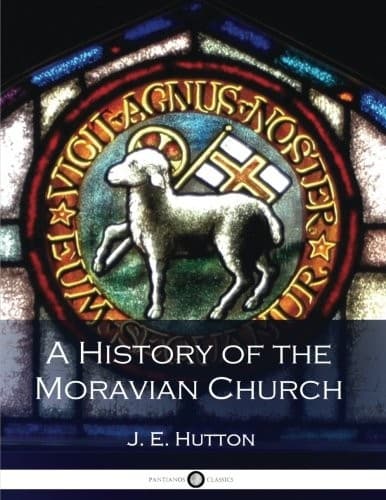
A History of the Moravian ChurchHutton, J. E. (Joseph Edmund)
Religion
A History of the Moravian Church
Hutton, J. E. (Joseph Edmund)
Moravian Church -- History
The appeal was pathetic and sincere. It fell on adders' ears. His scheme
found favour neither with Brethren nor with Utraquists. To the Brethren
Augusta was a Jesuitical juggler. To the Utraquists he was a supple
athlete trying to dodge his way out of prison.
"You shift about," wrote the Brethren, "in a most remarkable manner. You
make out the Utraquist Church to be different from what it really is, in
order to keep a door open through which you may go." In their judgment
he was nothing less than an ambitious schemer. If his scheme were
carried out, they said, he would not only be First Elder of the
Brethren's Church, but administrator of the whole united Church.
At last, however, King Maximilian interceded with the Emperor in his
favour, and Augusta was set free on the one condition that he would not
preach in public {1564.}. His hair was white; his beard was long; his
brow was furrowed; his health was shattered; and he spent his last days
amongst the Brethren, a defeated and broken-hearted man. He was
restored to his old position as First Elder; he settled down again at
Jungbunzlau; and yet somehow the old confidence was never completely
restored. In vain he upheld his daring scheme of union. John Blahoslaw
opposed him to the teeth. For the time, at least, John Blahoslaw was
in the right. Augusta throughout had made one fatal blunder. As the
Utraquists were now more Protestant in doctrine he thought that they
had begun to love the Brethren. The very contrary was the case. If two
people agree in nine points out of ten, and only differ in one, they
will often quarrel more fiercely with each other than if they disagreed
in all the ten. And that was just what happened in Bohemia. The more
Protestant the Utraquists became in doctrine, the more jealous they
were of the Brethren. And thus Augusta was honoured by neither party.
Despised by friend and foe alike, the old white-haired Bishop tottered
to the silent tomb. "He kept out of our way," says the sad old record,
"as long as he could; he had been among us long enough." As we think
of the noble life he lived, and the bitter gall of his eventide, we may
liken him to one of those majestic mountains which tower in grandeur
under the noontide sun, but round whose brows the vapours gather as
night settles down on the earth. In the whole gallery of Bohemian
portraits there is none, says Gindely, so noble in expression as his;
and as we gaze on those grand features we see dignity blended with
sorrow, and pride with heroic fire.[43]
CHAPTER XII. -- THE GOLDEN AGE, 1572-1603.
Public-domain text, read in full here on John Shaqi.
Reviews
Reviews
No reviews yet
Be the first to share your thoughts on this work.
Elsewhere in the archive
Join the Discussion
Join the discussion
Sign in to leave a comment or review.
Sign InorCreate an account