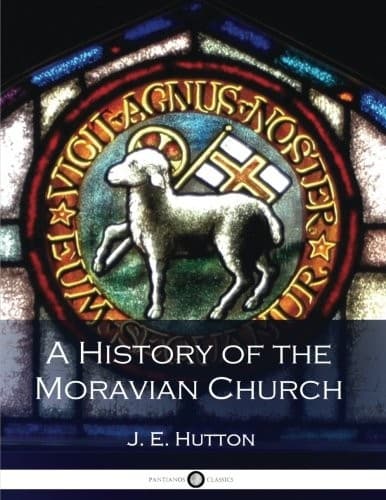
A History of the Moravian ChurchHutton, J. E. (Joseph Edmund)
Religion
A History of the Moravian Church
Hutton, J. E. (Joseph Edmund)
Moravian Church -- History
As the Emperor Maximilian II. set out from the Royal Castle in Prague
for a drive he met a baron famous in all the land {1575.}. The baron was
John von Zerotin, the richest member of the Brethren's Church. He had
come to Prague on very important business. His home lay at Namiest,
in Moravia. He lived in a stately castle, built on two huge crags, and
surrounded by the houses of his retainers and domestics. His estate was
twenty-five miles square. He had a lovely park of beeches, pines and old
oaks. He held his court in kingly style. He had gentlemen of the chamber
of noble birth. He had pages and secretaries, equerries and masters
of the chase. He had valets, lackeys, grooms, stable-boys, huntsmen,
barbers, watchmen, cooks, tailors, shoemakers, and saddlers. He had sat
at the feet of Blahoslaw, the learned Church historian: he kept a Court
Chaplain, who was, of course, a pastor of the Brethren's Church; and now
he had come to talk things over with the head of the Holy Roman Empire.
The Emperor offered the Baron a seat in his carriage. The Brother and
the Emperor drove on side by side.
"I hear," said the Emperor, "that the Picards are giving up their
religion and going over to the Utraquists."
The Baron was astounded. He had never, he said, heard the slightest
whisper that the Brethren intended to abandon their own Confessions.
"I have heard it," said the Emperor, "as positive fact from Baron
Hassenstein himself."
"It is not true," replied Zerotin.
"What, then," said the Emperor, "do the Utraquists mean when they say
that they are the true Hussites, and wish me to protect them in their
religion?"
"Your gracious Majesty," replied Zerotin, "the Brethren, called Picards,
are the true Hussites: they have kept their faith unsullied, as you may
see yourself from the Confession they presented to you."[44]
The Emperor looked puzzled. He was waxing old and feeble, and his memory
was failing.
"What!" he said, "have the Picards got a Confession?"
He was soon to hear the real truth of the matter. For some months there
had sat in Prague a committee of learned divines, who had met for the
purpose of drawing up a National Protestant Bohemian Confession. The
dream of Augusta seemed to be coming true. The Brethren took their
part in the proceedings. "We are striving," said Slawata, one of their
deputies, "for peace, love and unity. We have no desire to be censors of
dogmas. We leave such matters to theological experts." The Confession[45] was prepared, read out at the Diet, and presented to the Emperor. It
was a compromise between the teaching of Luther and the teaching of
the Brethren. In its doctrine of justification by faith it followed the
teaching of Luther: in its doctrine of the Lord's Supper it inclined to
the broader evangelical view of the Brethren. The Emperor attended the
Diet in person, and made a notable speech.
Public-domain text, read in full here on John Shaqi.
Reviews
Reviews
No reviews yet
Be the first to share your thoughts on this work.
Elsewhere in the archive
Join the Discussion
Join the discussion
Sign in to leave a comment or review.
Sign InorCreate an account