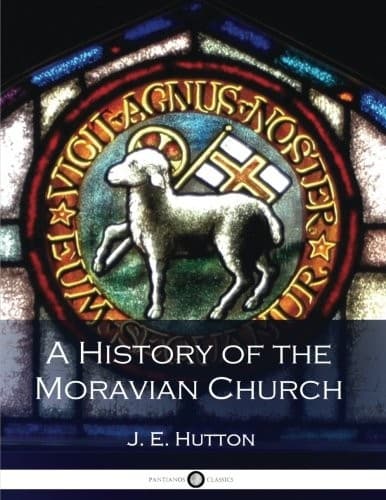
A History of the Moravian ChurchHutton, J. E. (Joseph Edmund)
Religion
A History of the Moravian Church
Hutton, J. E. (Joseph Edmund)
Moravian Church -- History
Third, the Brethren, in all their schools, made regular use of
hymn-books; and the scholar learnt to sing by singing hymns. Sometimes
the hymns were in a separate volume; sometimes a selection was bound up
with the Catechism. But in either case the grand result was the same.
As we follow the later fortunes of the Brethren we shall find ourselves
face to face with a difficult problem. How was it, we ask, that in later
years, when their little Church was crushed to powder, these Brethren
held the faith for a hundred years? How was it that the "Hidden Seed"
had such vitality? How was it that, though forbidden by law, they held
the fort till the times of revival came? For answer we turn to their
Catechism. They had learned it first in their own homes; they had
learned it later at school; they had made it the very marrow of their
life; they taught it in turn to their children; and thus in the darkest
hours of trial they handed on the torch of faith from one generation to
another.
We come now to another secret of their strength. Of all the Protestants
in Europe the Bohemian Brethren were the first to publish a Hymn-book;
and by this time they had published ten editions. The first three were
in Bohemian, and were edited by Luke of Prague, 1501, 1505, 1519; the
fourth in German, edited by Michael Weiss, 1531; the fifth in Bohemian,
edited by John Horn, 1541; the sixth in German, edited by John Horn,
1544; the seventh in Polish, edited by George Israel, 1554; the eighth
in Bohemian, edited by John Blahoslaw, 1561; the ninth in German, 1566;
the tenth in Polish, 1569. As they wished here to appeal to all classes,
they published hymns both ancient and modern, and tunes both grave and
gay. Among the hymn-writers were John Hus, Rockycana, Luke of Prague,
Augusta, and Martin Luther; and among the tunes were Gregorian Chants
and popular rondels of the day. The hymns and tunes were published
in one volume. The chief purpose of the hymns was clear religious
instruction. The Brethren had nothing to conceal. They had no mysterious
secret doctrines; and no mysterious secret practices. They published
their hymn-books, not for themselves only, but for all the people in the
country, and for Evangelical Christians in other lands. "It has been
our chief aim," they said, "to let everyone fully and clearly understand
what our views are with regard to the articles of the Christian faith."
And here the hymns were powerful preachers of the faith. They spread
the Brethren's creed in all directions. They were clear, orderly,
systematic, and Scriptural; and thus they were sung in the family
circle, by bands of young men in the Brethren's Houses, by shepherds
watching their flocks by night, by sturdy peasants as they trudged to
market. And then, on Sunday, in an age when congregational singing was
as yet but little known, the Brethren made the rafters ring with
the sound of united praise. "Your churches," wrote the learned Esrom
Rüdinger, "surpass all others in singing.
Public-domain text, read in full here on John Shaqi.
Reviews
Reviews
No reviews yet
Be the first to share your thoughts on this work.
Elsewhere in the archive
Join the Discussion
Join the discussion
Sign in to leave a comment or review.
Sign InorCreate an account