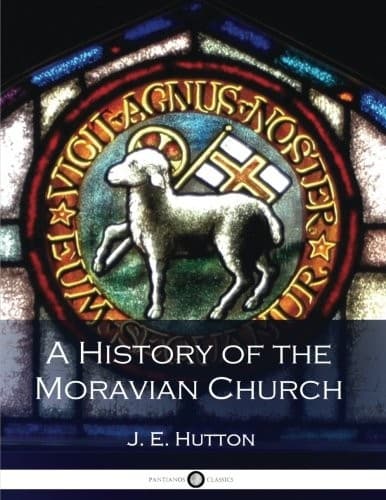
A History of the Moravian ChurchHutton, J. E. (Joseph Edmund)
Religion
A History of the Moravian Church
Hutton, J. E. (Joseph Edmund)
Moravian Church -- History
For where else are songs of
praise, of thanksgiving, of prayer and instruction so often heard? Where
is there better singing? The newest edition of the Bohemian Hymn-book,
with its seven hundred and forty-three hymns, is an evidence of
the multitude of your songs. Three hundred and forty-six have been
translated into German. In your churches the people can all sing and
take part in the worship of God."
But of all the services rendered by the Brethren to the cause of the
evangelical faith in Bohemia the noblest and the most enduring was their
translation of the Bible into the Bohemian tongue. In the archives of
the Brethren's Church at Herrnhut are now to be seen six musty
volumes known as the Kralitz Bible (1579-93). The idea was broached by
Blahoslaw, the Church historian. The expense was born by Baron John
von Zerotin. The actual printing was executed at Zerotin's Castle at
Kralitz. The translation was based, not on the Vulgate, but on the
original Hebrew and Greek. The work of translating the Old Testament
was entrusted to six Hebrew scholars, Aeneas, Cepollo, Streic, Ephraim,
Jessen, and Capito. The New Testament was translated by Blahoslaw
himself (1565). The work was of national interest. For the first time
the Bohemian people possessed the Bible in a translation from the
original tongue, with the chapters subdivided into verses, and the
Apocrypha separated from the Canonical Books. The work appeared at first
in cumbersome form. It was issued in six bulky volumes, with only eight
or nine verses to a page, and a running commentary in the margin. The
paper was strong, the binding dark brown, the page quarto, the type
Latin, the style chaste and idiomatic, and the commentary fairly rich in
broad practical theology. But all this was no use to the poor. For the
benefit, therefore, of the common people the Brethren published a small
thin paper edition in a plain calf binding. It contained an index of
quotations from the Old Testament in the New, an index of proper names
with their meanings, a lectionary for the Christian Year, references
in the margin, and a vignette including the famous Brethren's episcopal
seal, "The Lamb and the Flag." The size of the page was only five inches
by seven and a half; the number of pages was eleven hundred and sixty;
the paper was so remarkably thin that the book was only an inch and a
quarter thick;[47] and thus it was suited in every way to hold the same
place in the affections of the people that the Geneva Bible held in
England in the days of our Puritan fathers. The Kralitz Bible was
a masterpiece. It helped to fix and purify the language, and thus
completed what Stitny and Hus had begun. It became the model of a chaste
and simple style; and its beauty of language was praised by the Jesuits.
It is a relic that can never be forgotten, a treasure that can never
lose its value. It is issued now, word for word, by the British and
Foreign Bible Society; it is read by the people in their own homes,
Public-domain text, read in full here on John Shaqi.
Reviews
Reviews
No reviews yet
Be the first to share your thoughts on this work.
Elsewhere in the archive
Join the Discussion
Join the discussion
Sign in to leave a comment or review.
Sign InorCreate an account