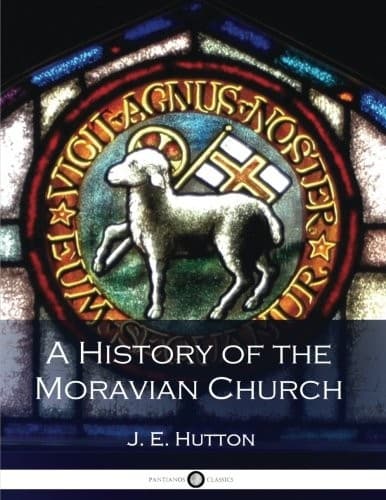
A History of the Moravian ChurchHutton, J. E. (Joseph Edmund)
Religion
A History of the Moravian Church
Hutton, J. E. (Joseph Edmund)
Moravian Church -- History
At the same time, when opportunity offered, John Hus made a practice of
preaching on the burning topics of the day; and the most popular topic
then was the detested power of Germans in Bohemia. German soldiers
ravaged the land; German nobles held offices of state; and German
scholars, in Prague University, had three-fourths of the voting power.
The Bohemian people were furious. John Hus fanned the flame. "We
Bohemians," he declared in a fiery sermon, "are more wretched than dogs
or snakes. A dog defends the couch on which he lies. If another dog
tries to drive him off, he fights him. A snake does the same. But us the
Germans oppress. They seize the offices of state, and we are dumb. In
France the French are foremost. In Germany the Germans are foremost.
What use would a Bohemian bishop or priest, who did not know the German
language, be in Germany? He would be as useful as a dumb dog, who cannot
bark, to a flock of sheep. Of exactly the same use are German priests
to us. It is against the law of God! I pronounce it illegal." At last a
regulation was made by King Wenceslaus that the Bohemians should be more
fairly represented at Prague University. They had now three votes out
of four. John Hus was credited by the people with bringing about the
change. He became more popular than ever.
If Hus had only halted here, it is probable that he would have been
allowed to die in peace in his bed in a good old age, and his name would
be found enrolled to-day in the long list of Catholic saints. However
wicked the clergy may have been, they could hardly call a man a heretic
for telling them plainly about the blots in their lives. But Hus soon
stepped outside these narrow bounds. The more closely he studied the
works of Wycliffe, the more convinced he became that, on the whole,
the great English Reformer was right; and before long, in the boldest
possible way, he began to preach Wycliffe's doctrines in his sermons,
and to publish them in his books. He knew precisely what he was doing.
He knew that Wycliffe's doctrines had been condemned by the English
Church Council at Black-Friars. He knew that these very same doctrines
had been condemned at a meeting of the Prague University Masters. He
knew that no fewer than two hundred volumes of Wycliffe's works had been
publicly burned at Prague, in the courtyard of the Archbishop's Palace.
He knew, in a word, that Wycliffe was regarded as a heretic; and yet he
deliberately defended Wycliffe's teaching. It is this that justifies us
in calling him a Protestant, and this that caused the Catholics to call
him a heretic.
Public-domain text, read in full here on John Shaqi.
Reviews
Reviews
No reviews yet
Be the first to share your thoughts on this work.
Join the Discussion
Join the discussion
Sign in to leave a comment or review.
Sign InorCreate an account