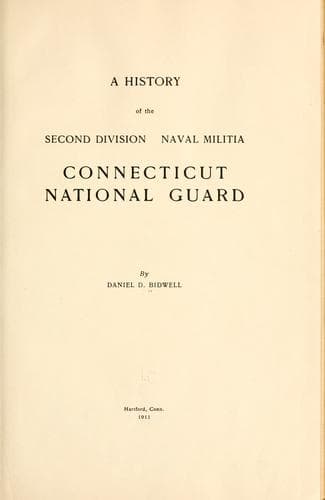
A History of the Second Division Naval Militia Connecticut National Guard — John Shaqi
A History of the Second Division Naval Militia Connecticut National GuardBidwell, Daniel Doane
History
A History of the Second Division Naval Militia Connecticut National Guard
Bidwell, Daniel Doane
Connecticut. Militia
Probably the most memorable occasion in the history of the command was
September 30, 1899, “Dewey Day,” the day of the giant procession in New
York City in honor of the fine old hero of Manila Bay. When the
organizations to represent this state were selected, it was the Naval
Battalion which headed the list of honor. The First Regiment was not
upon the list, but with honorable patriotism officers of the regiment
who had served in Camp Alger requested of Lieutenant Lyman Root,
Lieutenant Parker’s successor, permission to wear the sailor blue and
carry Springfields in the division ranks. Men who had served in distant
years in the wooden navy and men who had fought under Dyer in Manila Bay
and Wainwright in the combat with the Furor and the Pluton and had
returned to Hartford, also asked and received the same permission.
With four officers and 112 men the division swung out from the armory on
the evening of the 29th and amid red fire and with a band blaring at the
front paraded to the railroad station, envied by infantrymen who could
not obtain opportunity to march in the mammoth procession. At 11 o’clock
the company marched into the Second Regiment Armory in New Haven,
stacked arms and was dismissed for a midnight lunch, at which the men
stowed away steaming coffee and ham sandwiches and received strict
orders not to leave the building. Then they made living pillows of one
another and slumbered innocently on benches in the gallery till some
wee, sma’ hour or other in the morning, when the Second Regiment crashed
out with “Onward Christian Soldiers,” and summoned them back to the
world of consciousness and sin. At 3 o’clock they fell in and marched
out into a hospitable rain punctuated by milkmen and policemen.
Three-quarters of an hour later they boarded the side-wheeler
Shinnecock. At 4 o’clock the steamer got under way and the men began to
look forward to a night of rest. One man slept on his arm under a table
in the dining saloon piled six feet high with camp chairs. Another was
lost to the world under the break of the pilot house. Still another
slept on unbaled hay for the field officers of the Second Regiment. Some
slumbered in gangways and some on the paddle boxes. The mathematical
boys of the division demonstrated the problem that it was possible to
sleep anywhere in space.
Somewhere in the head of the Sound the Shinnecock fell on an evil time.
A bushing on a feathering paddle blade in the starboard wheel misbehaved
and a bar buckled and for three hours she drifted while engineers made
repairs. Finally an emergency landing was made in a convenient coal yard
in Port Morris and the battalion trotted at double time for two miles
over Harlem cobblestones, arriving just in time to fall in ahead of
General Oliver O. Howard and the Grand Army Division.
Public-domain text, read in full here on John Shaqi.
Reviews
Reviews
No reviews yet
Be the first to share your thoughts on this work.
Join the Discussion
Join the discussion
Sign in to leave a comment or review.
Sign InorCreate an account